A Celebration Of Hank Williams’ 100th Birthday With A Playlist And Some Ramblin’ About A Ramblin’ Man
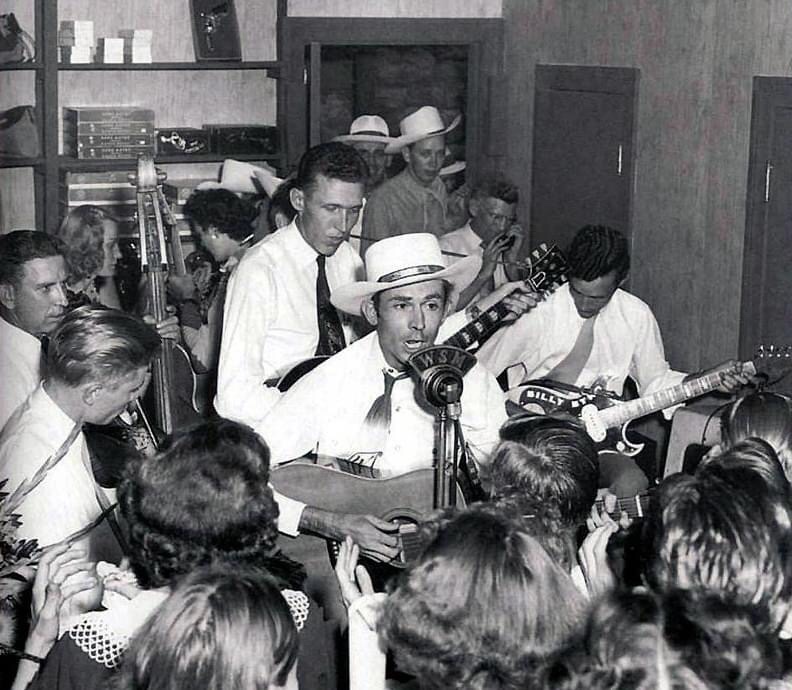
A year ago today I put together a playlist of 99 Hank Williams songs with every intention of adding one more today to celebrate Hank’s 100th birthday (I should have trademarked “Hank 100” when I thought of it a year ago!). However, I made a completely different playlist. Every Hank mixtape/CD mix that I’ve ever made began with the complete sequence of Lost Highway And Other Folk Ballads, a 1964 compilation that was the first Hank album I ever owned, and last year’s playlist began that same way. For this one I decided to pick my favorite songs in the order with which they were released on the first several long playing albums of Hank Williams music. As a lifelong music freak and record collector, I’m fascinated with the history of music and the music business. Hank’s recording career and the recordings his record label MGM released in his lifetime, and the massive amount of material released after his death have become an obsession of mine over the years. First, let me explain how I came to love the “Hillbilly Shakespeare”.
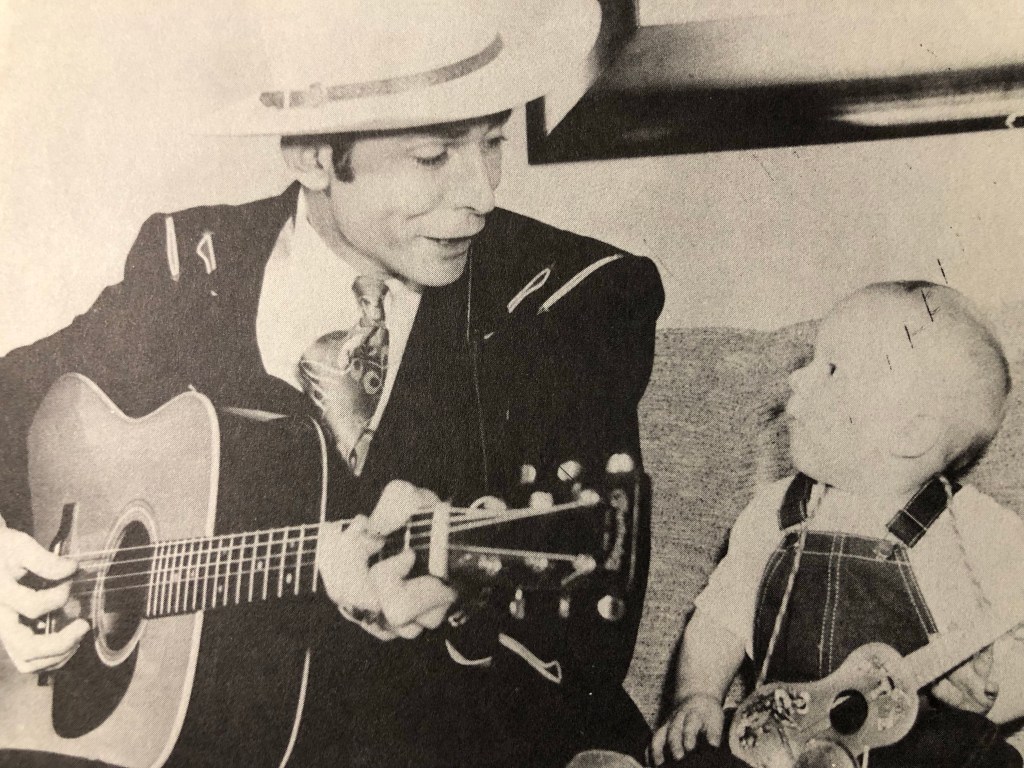
I first heard Hank Williams when I was a young child, maybe 5 or 6 years old. I was crazy about Elvis, and another young kid that lived across the street, whose name I can’t recall, was explaining to me that his parents didn’t let him listen to Rock ‘N’ Roll (this was like 1972-ish). As I was inside his house one day, he showed me the family record collection which was mostly Gospel and Country records. “Have you heard Hank Williams? He’s kind of like Elvis, but Country.” I didn’t exactly get that then and I laugh thinking back that this was the insightful analysis of a young child, but it’s true that Hank was an Elvis-like phenomenon in the Country world. Many who witnessed both Williams and Presley’s rise have pointed out the similarities. The kid played “Hey Good Lookin’” for me. The lyrics were funny and it was a catchy song, but it would take many years for me to understand it. George Thorogood’s 1978 cover of “Move It On Over” made it pretty obvious to me at that point what Hank’s influence on Rock ‘N’ Roll was. That sentiment reinforced when my Grandpa told me “Hank Williams was too Rock ‘N’ Roll for me.” I’ve been blessed with a family that loves music, and I have three different uncles that loved Hank Williams. I would hear many Hank songs growing up and always liked them, but it wasn’t until my mid-20s that I bought that first Hank record, subsequently followed by a couple of “greatest hits” collections, that his music really hit me. As the 21st Century began I had become engrossed more and more in the Blues, Jazz, and Country music of the early 20th.
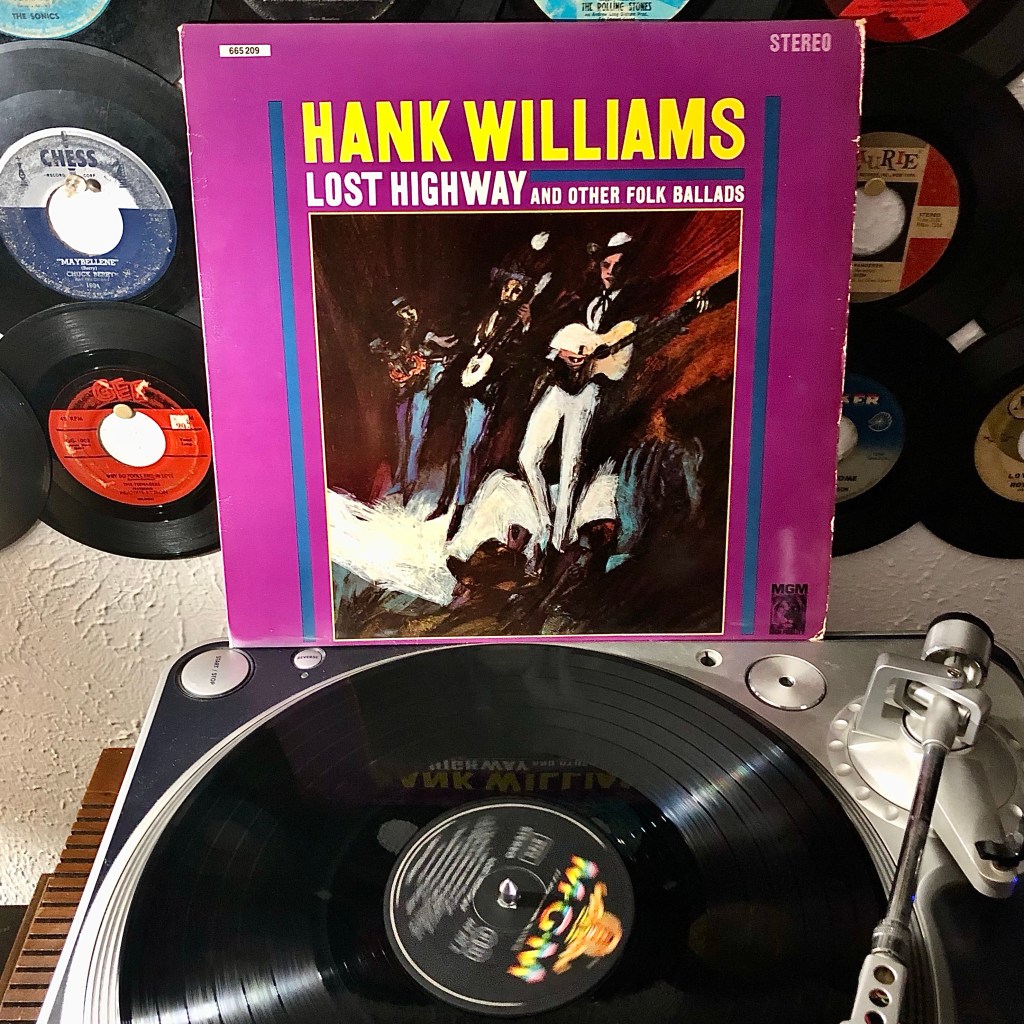
Playlist for Lost Highway And Other Folk Ballads
To say I’m kind of stuck in the 20th Century would be an understatement. I didn’t own a computer until 2005. The transition from making mixtapes to mix CDs caused one friend to tease me “Welcome to the ‘90s!” It was that same year that one of my cool uncles let me borrow The Complete Hank Williams, a 10-CD box set released in 1998. I spent months listening to all 225 tracks and reading every word of the liner notes. I made several mix CDs: one of Hank’s hits, one of more hits and B-sides, one of his alter-ego Luke The Drifter and even more lesser known tunes, one of Gospel tunes, and my favorite, one full of “Hank & his guitar” demos and live recordings. The set boasted 53 previously unreleased tracks, which was kind of hard to believe. That’s because many of them had never been heard in their original undubbed versions till then. If you know me, you have heard my rants before about the “overdubbed/undubbed” issue. Many of these previously unreleased tracks were demos of just Hank and his guitar or solo performances recorded live on the radio. One can assume he would have re-recorded some of the songs with the steel guitar, fiddle, electric guitar and standup bass of his Drifting Cowboys, so that’s exactly what MGM Records, along with Hank’s producer/mentor Fred Rose did in the years following his death. They brought in members of the Drifting Cowboys to overdub the parts that was assumed Hank would have wanted. Later on they would do this with other session musicians, including Chet Atkins and Hank Snow. Suddenly there would be Country-style piano on some of these songs. Hank never used piano. Or suddenly there would be a bass drum or snare brushes, and sometimes some added electric guitar that hadn’t been there before. These moves were most likely an attempt to modernize Hank’s sound during the Country music boom of the ‘50s and early ‘60s, a golden era directly influenced by Hank Williams.
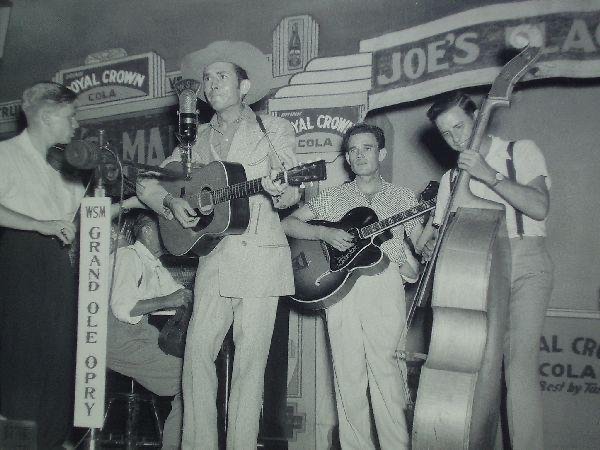
“Lost Highway” overdubbed version
The worst is not just the demos, but classic songs like “Lost Highway”, which had already been recorded with Hank’s band, with its signature steel guitar part, but now was “enhanced” with unnecessary extra instrumentation. For some fans, their first introduction to Hank’s music was the “Nashville Sound” of adding strings. While some may enjoy these “remixes”, I’m that purist that prefers the original recordings. Understand, I first heard most of these songs in the undubbed versions on the box set before I began collecting the vinyl versions, but l love Hank’s music so much that I find enjoyment in all the different versions. It is however kind of bizarre to hear the crackling of an acetate recording and Hank’s lo-fi vocals, mixed with more modern early ‘60s sounds.
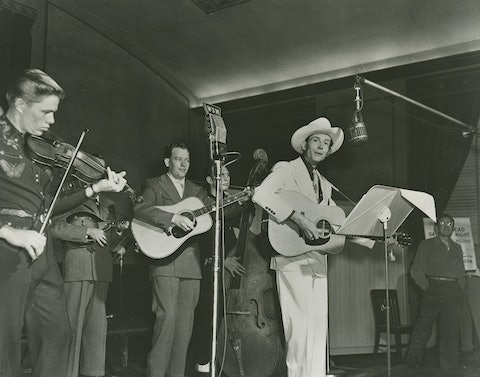
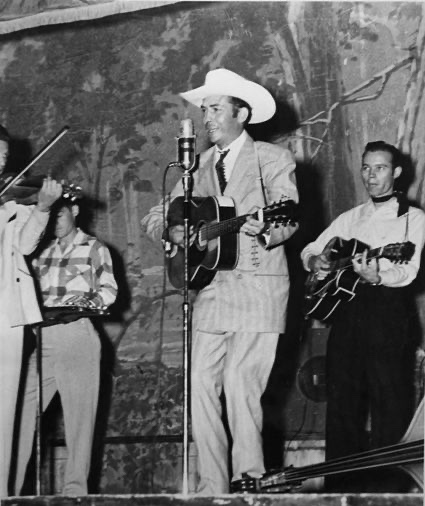
Hank 100 playlist on YouTube
Hank 100 playlist on Spotify
https://spotify.link/tvnTw5wRaDb
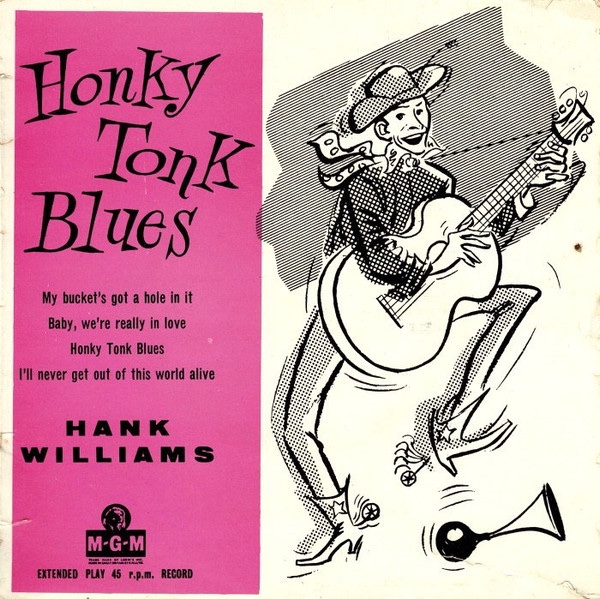
Let’s get to my playlist. As usual, I’ve made two versions, one for YouTube and one for Spotify. They’re pretty much the same except for some reason the demo version of “My Bucket’s Got A Hole In It” from The Complete Hank Williams is not available on Spotify, so I replaced it with a demo of “Your Cheatin’ Heart”. As I stated earlier, the playlist follows in sequence the first several albums released by MGM and I’m gonna discuss each one.
Hank Williams Sings (1951)
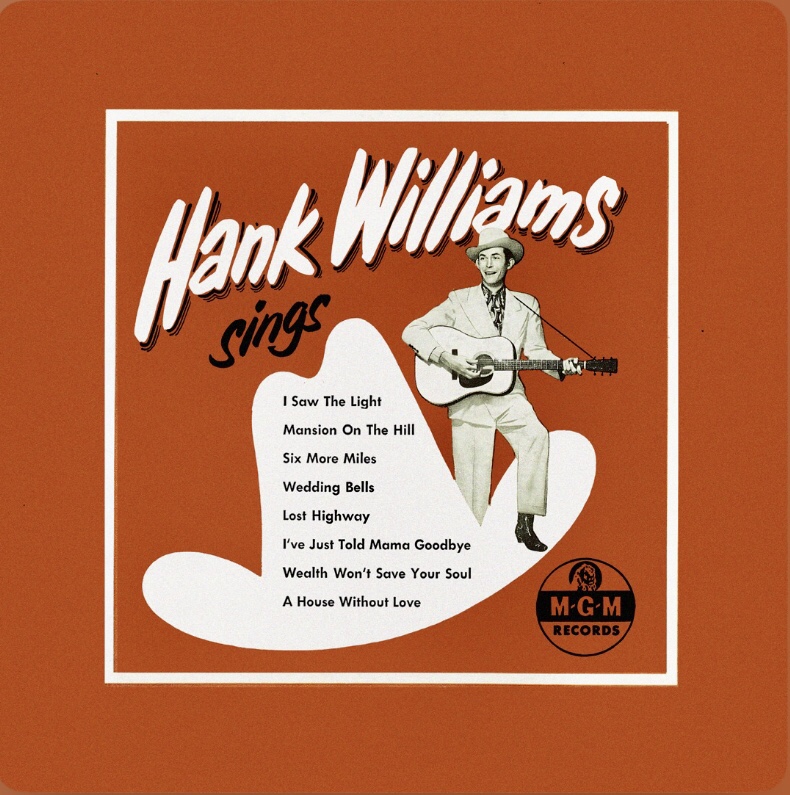
One of the many aspects of Hank Williams’ career that fascinates me endlessly is how MGM Records released his records, before and after his passing. He had released 31 singles and two 10” “mini-albums” in his six year recording career. MGM released his first six albums in a very unusual manner. When Hank began his recording career, the 78 rpm single was the dominant format, with the 45 rpm single arriving in 1949. The long playing disc (or LP) dates back to Edison in 1926, but it was RCA Victor that came out with the first commercial 33 1/3 rpm 12” in 1931, however since few could afford the playing equipment during the Depression, it was a failure. In 1948, Columbia Records improved the technology with its “microgroove” vinyl disc that could hold 23 minutes of music per side. However it would be almost another decade before the LP would outsell 45s and make the 78 single obsolete. When MGM decided to release Hank’s first LP, Hank Williams Sings, it was a 8-song 10” 33 1/3 rpm disc, but because LPs were still considered a bit of a novelty, it was also released in 4-disc sets in both the 78 and 45 formats. They would repeat this weird marketing method for his first six albums, also releasing 2-disc 45 Extended Play (EP) sets. They would later reissue these albums as 12-song 12” LPs with additional tracks, except for his first album.
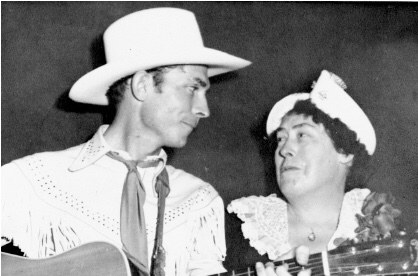
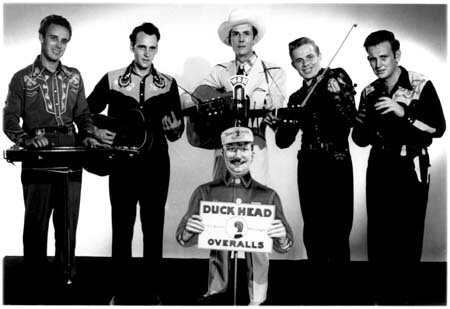
Various people played roles in Hank Williams’ career, including his mother Lillie who recognized his gift early on, buying him a harmonica at 6 and his first guitar at 8, and fully supported her son when he began performing at the age of 13, and his first wife Audrey, who competed with his mother in trying to manage his career. To explain in full context the impact that Audrey had on Hank, and all the pain and inspiration that their troubled marriage serves as the core of his legend, it would make this far longer than it already is. Just watch the underrated film I Saw The Light (2015) if you need to explore that part of the story more. I believe the more significant people, as far as his recording career is concerned, were his producer/mentor Fred Rose and Frank Walker, the head of MGM Records. In 1942, Rose teamed up with Roy Acuff, Country music icon and Hank’s idol, to form the Acuff-Rose publishing company. After coming to Nashville to audition in 1946, Fred signed Hank to an exclusive songwriting deal with Acuff-Rose, and secured him a contract with Sterling Records who would release his first four singles. Frank Walker was a talent scout and A&R rep for both Columbia and RCA Victor, who was brought out of retirement by the Metro-Goldwyn-Mayer film studio to head their new record label, MGM. Walker had discovered Bessie Smith and Blind Willie Johnson, and helped the careers of Al Jolson, Artie Shaw, Duke Ellington, Glenn Miller, Coleman Hawkins, Bob Wills, and Eddie Arnold to name a few. Walker gave Rose complete control over what Hank Williams songs would be released as singles, and eventually LPs too. Hank’s first MGM release, “Move On It Over” went to #4 on the Country charts (a song many consider an early example of Rock ‘N’ Roll). While he had a few misses, most of his singles released during his lifetime were in the top 10.
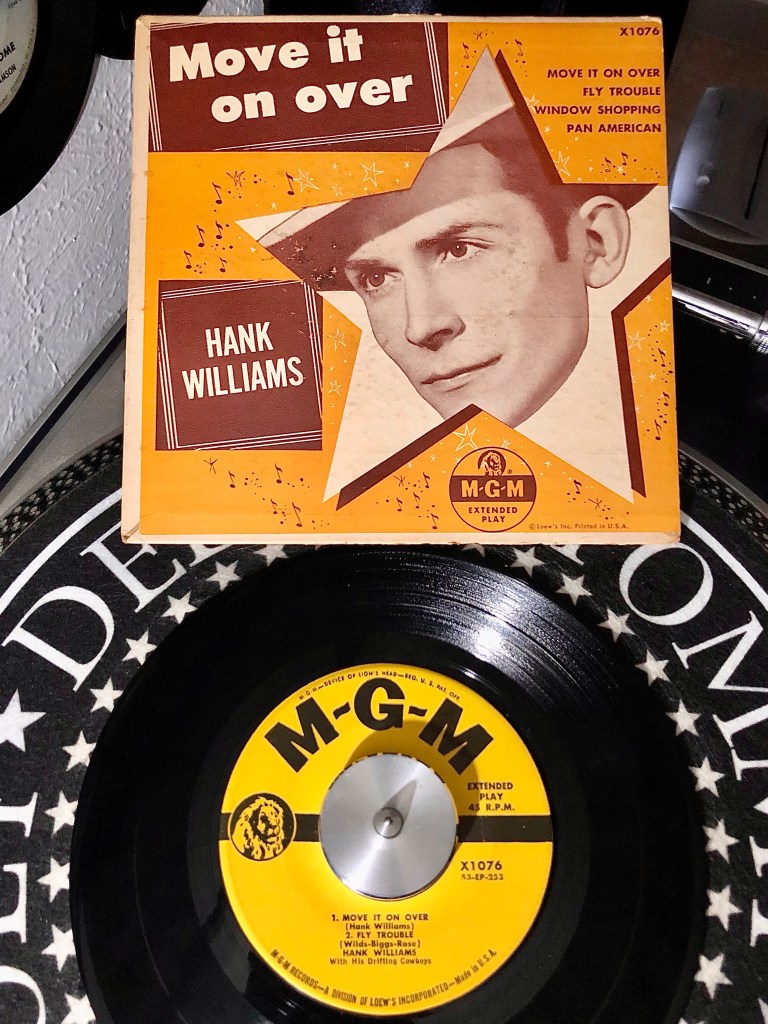
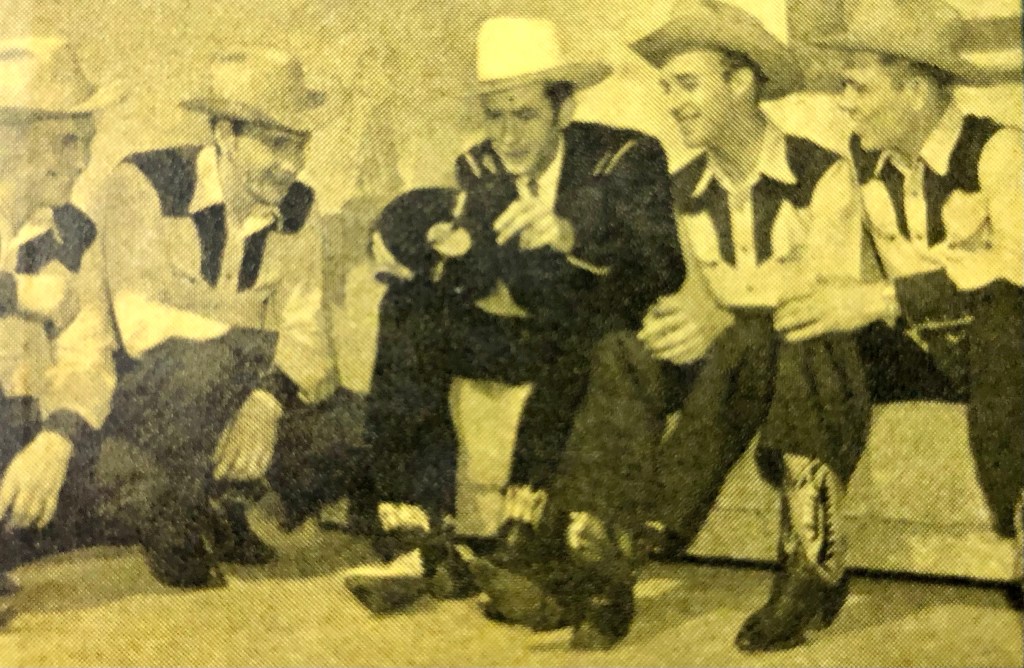
At this time the success of any song was measured by disc jockey and jukebox plays, so if the A-side was a hit and the B-side got little to no play, it was considered a dud. When the idea of compiling an album came about, Rose picked two hits, “Wedding Bells” and “Mansion On The Hill”, and six other songs that hadn’t sold well. It’s hard to believe today that “Lost Highway” was not considered a hit. It was the B-side of another #4 hit “You’re Gonna Change (Or I’m Gonna Leave)”. “Lost Highway”, written by Leon Payne, reached #12 on its own, but Rose considered it a bust, “I Saw The Light” and “Six More Miles (To The Graveyard)”, were released together as a single that didn’t even chart, but their inclusion on Hank’s debut album meant Rose thought they were worth giving another chance. One may assume that Hank had some input on what songs appeared on both of the albums that were released before his death, but he trusted Rose. The album format was still so new, Hank probably didn’t care. He wrote the songs and sang them, and had…um, other problems.

Hank Williams Sings was not even a full album, but a 8-song 10” mini-album, and the eight tunes were also pressed on 45 and 78 in four-disc sets. And here’s where things get really confusing. If you look it up on Discogs, all pressings of the 10” list the sequence of songs as they appear on the cover, beginning with “I Saw The Light” and ending with “A House Without Love”. Photos of the labels prove the sequence showing that side two begins with “Lost Highway”. However, both the 45 and 78 versions showcase the tunes in a different sequence, starting with “Lost Highway”, and ending with “Wedding Bells”. Many reviews I have found, both on Wikipedia and from many Hank historians, list the album beginning with “Lost Highway”, which is without a doubt the best song of the set and lends a legendary vibe to the idea that his first album starts with such a defining statement, except albums were not yet thought of as statement pieces. The only reason I can figure out is that it’s because of the hierarchy of the formats at the time. 78s & 45s were played on jukeboxes and by DJs, and the 10” & 12” LPs were simply novelties. Fast forward 72 years, and all digital streaming services present Hank Williams Sings in the original 10” sequence. This is the work of Mercury Nashville, the division of the Universal Music Group that now controls Hank’s catalog (more about them in a second) and released it digitally in 2021. After listening to both sequences, I really can’t say which is the better, but for my playlist, I decided to go with the one that begins with one of my favorite Hank songs. Although he didn’t write it, I can’t think of a better opening line than “I’m a rolling stone…”
Moanin’ The Blues (1952)
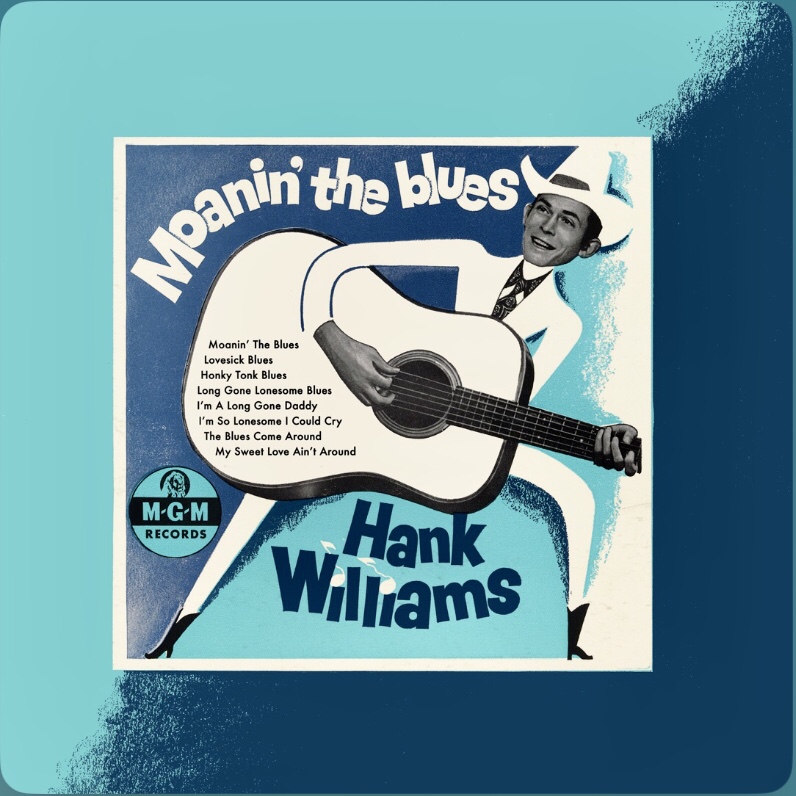
While historians and younger fans may put Hank Williams Sings on a list of great debut albums, it was essentially a flop. Again, LPs were not considered to be any kind of artistic statement at this point, and let’s not forget, both of Hank’s first two albums, and all Hank Williams LPs are compilations of previously released singles, demos and live recordings (just like Robert Johnson and Muddy Waters first albums). For Hank’s second album, Moanin’ The Blues, Fred Rose chose a different approach, and with a Blues theme, he selected several of Hank’s most popular hits, including “Lovesick Blues” (his first #1), “Long Gone Lonesome Blues”, “Honky Tonk Blues”, and the title track, plus “I’m So Lonesome I Could Cry”, a B-side that didn’t chart but is now widely considered the greatest song Hank ever wrote. Released in the same fashion, eight songs on 78 & 45 sets and a 10”, it wasn’t anymore successful than its predecessor, but it is one of the most powerful collections of Hank songs ever assembled.
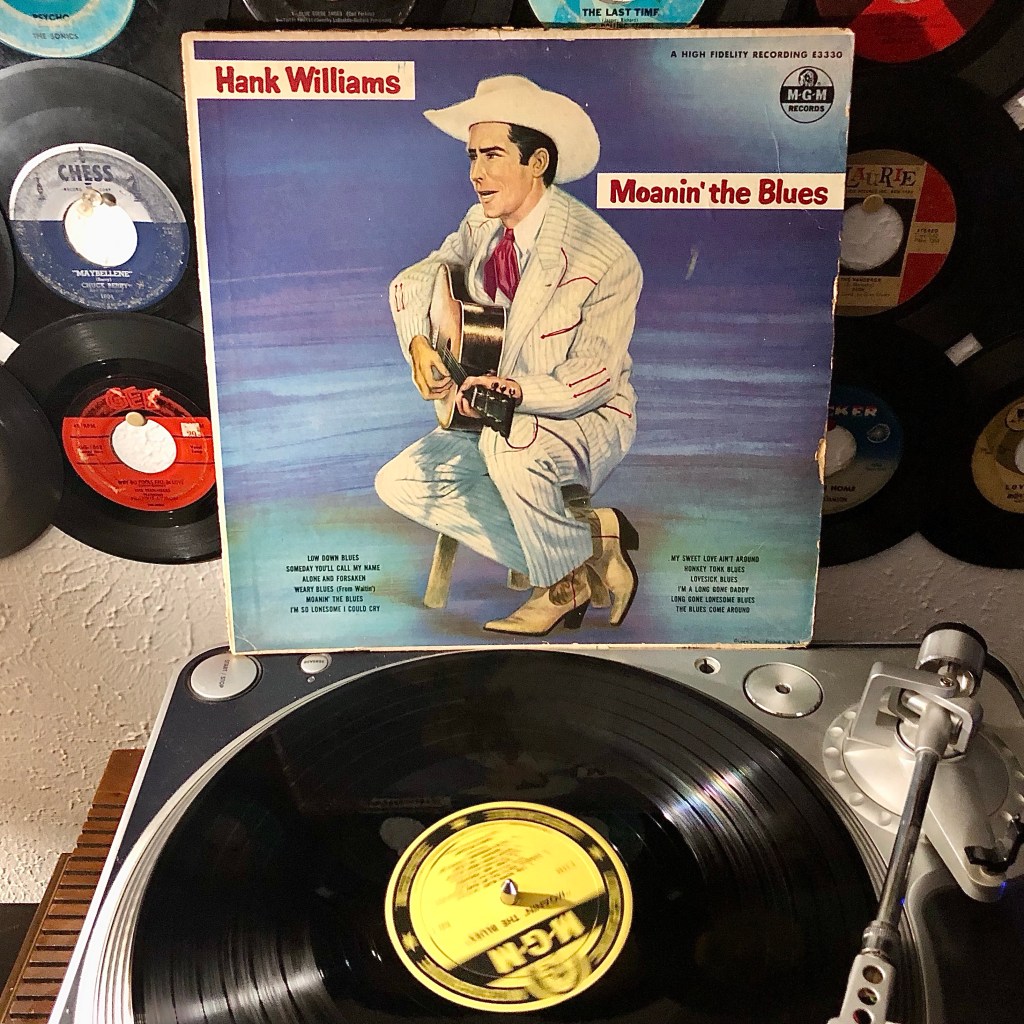
Moanin’ The Blues isn’t without its own weirdness. I own a 1956 reissue that includes the 2:10 version of “Honky Tonk Blues” recorded December 11, 1951 and released as a single the following February. The same version appears on my ‘57 reissue of Honky Tonkin’. However, the 2021 Mercury Nashville “Expanded Edition” of Moanin’ The Blues features the 2:42 version recorded in 1947, which begins with acoustic guitar and has a stand-up bass solo (not kidding). Hank had recorded many versions before the satisfactory ‘51 take that begins with a steel guitar (I’ve also included another version on the playlist, a solo “Hank & his guitar” version that’s my favorite). I would think the original 10” version of Moanin’ includes the ‘51 version, so why would the current digital version have the ‘47 take? Well, that’s only one interesting thing about the Expanded Edition.
When MGM released the ‘56 reissue it was the first expanded version with four songs added to the original eight for a full 12” long player. The four extra songs were previously unissued demos. The weird thing is the 12” version starts with these added tracks. “Low Down Blues” is a super lo-fi recording, possibly one of Hank’s home recordings on a 4-track device. It’s believed he wrote the song while recovering from a back injury related to his lifelong and undiagnosed case of spinal bifida. The song begins with the lyrics “Lord I went to the doctor, he took one look, he said the trouble with you ain’t in my book…” This is depicted in a scene in I Saw The Light that is then followed by a recording device being delivered to a bedridden Hank. I believe the 45 of “Low Down Blues”, released in 1954 may be the original version, but on this ‘56 LP, it’s a completely different experience all together. What you have is a completely new recording of the song that clocks in around 2:33 as opposed to the 1:18 of the original demo. It includes both a steel guitar and electric guitar solo, that ironically end around the 1:18 mark. They simply took Hank’s lo-fi voice and acoustic guitar and just punched it for the verses and choruses. It’s insane and I hated it the first time I heard it, but you gotta believe this is exactly how this song would have turned out if Hank had recorded it with his full band.

“Weary Blues From Waiting” overdubbed version
Surprisingly, “Someday You’ll Call My Name” and “Alone And Forsaken” are not touched, with Hank and his guitar flying solo, but the overdubbing returns on my absolute favorite Hank song, “Weary Blues From Waiting”, and it’s hard to blame them. I think “Weary” is one of the most underrated Hank Williams songs, belonging on the same level of “I’m So Lonesome I Could Cry”, and “I Can’t Help It (If I’m Still In Love With You)”. When released as a single in September of 1953, it shot up to #7 on the charts. Yet I still think the demo version is better. It’s just so heavy.
Through tears I watch young lovers
As they go strollin’ by
Oh, all the things that might have been
God forgive me if I cry
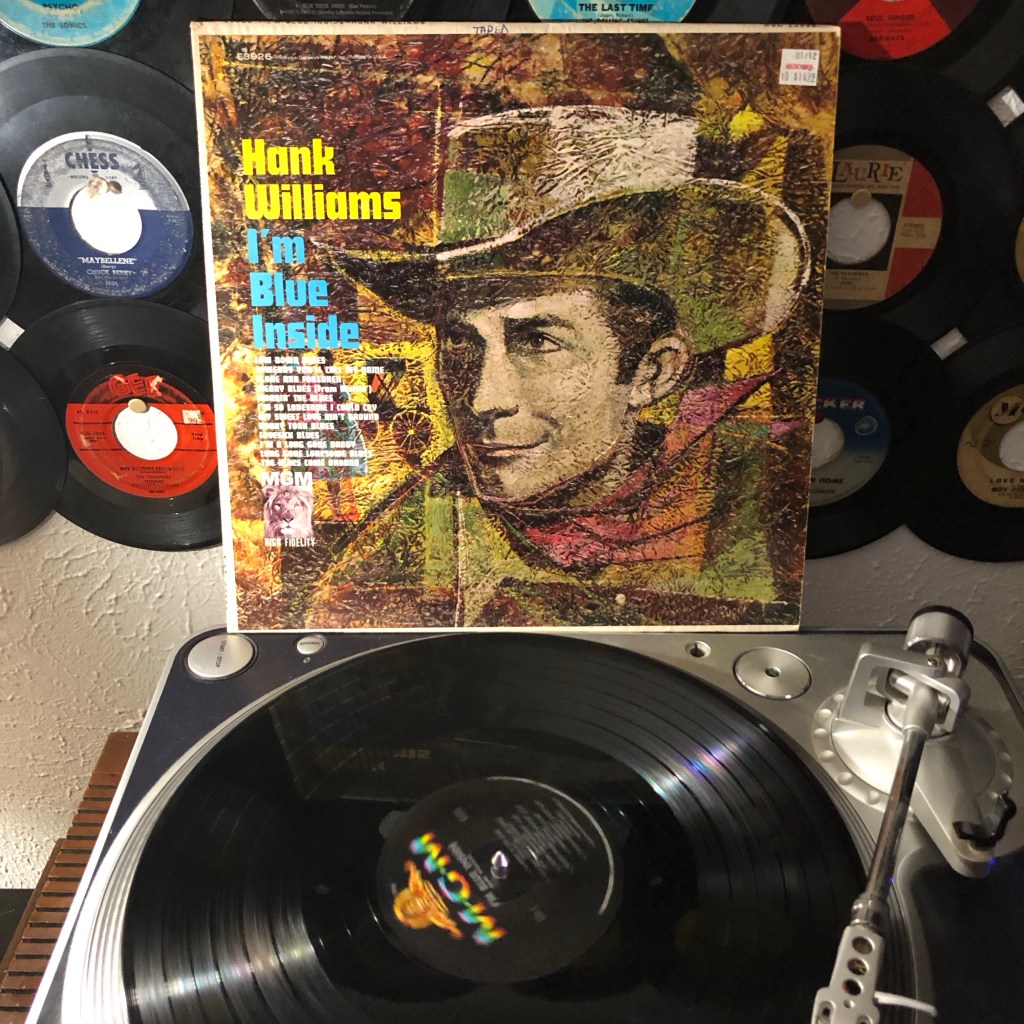
Those may be the saddest lyrics ever, but I digress. Thankfully the rest of the songs were not messed with and the retitled 1961 reissue I’m Blue Inside is exactly the same. I have to give Mercury Nashville major props with their Expanded Editions. By restoring all the undubbed versions of Hank’s songs, what they done may be the best thing since ZZ Top’s early records were remastered, taking those awful Six Pack mixes out. Now if they would reissue this sequence on vinyl… There must be some uber-music dorks working there because it’s like someone was allowed to piece together the ultimate fantasy version of Moanin’ The Blues, starting it off with the original 10” 8-song sequence, and then placing the four extra cuts in for the third act as opposed to starting the album off with them. It’s now really quite brilliantly front-loaded with all these hardcore honky-tonk epics, then takes this somber last stretch with some of Hank’s most heartbreaking ballads. The rawness of “Low Down Blues” is almost like throwing a Pussy Galore or Teengenerate song onto a mixtape, and “Weary Blues From Waiting” is restored to all its undubbed glory, making it a powerful finale to my favorite Hank Williams album.
Memorial Album (1953)
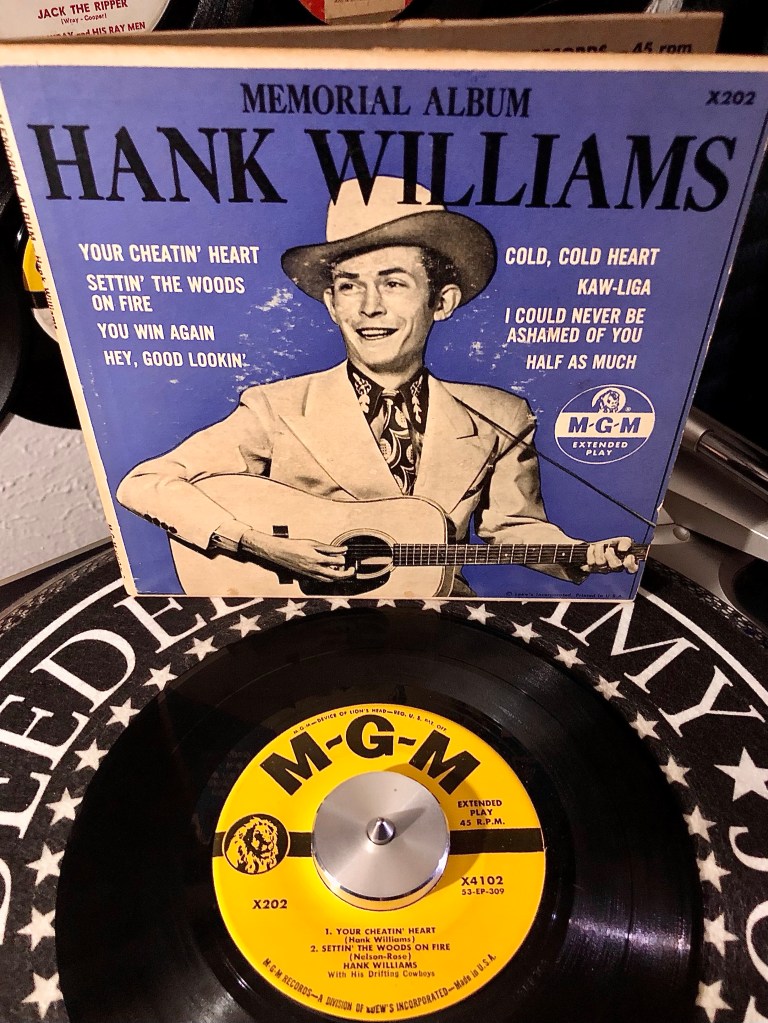
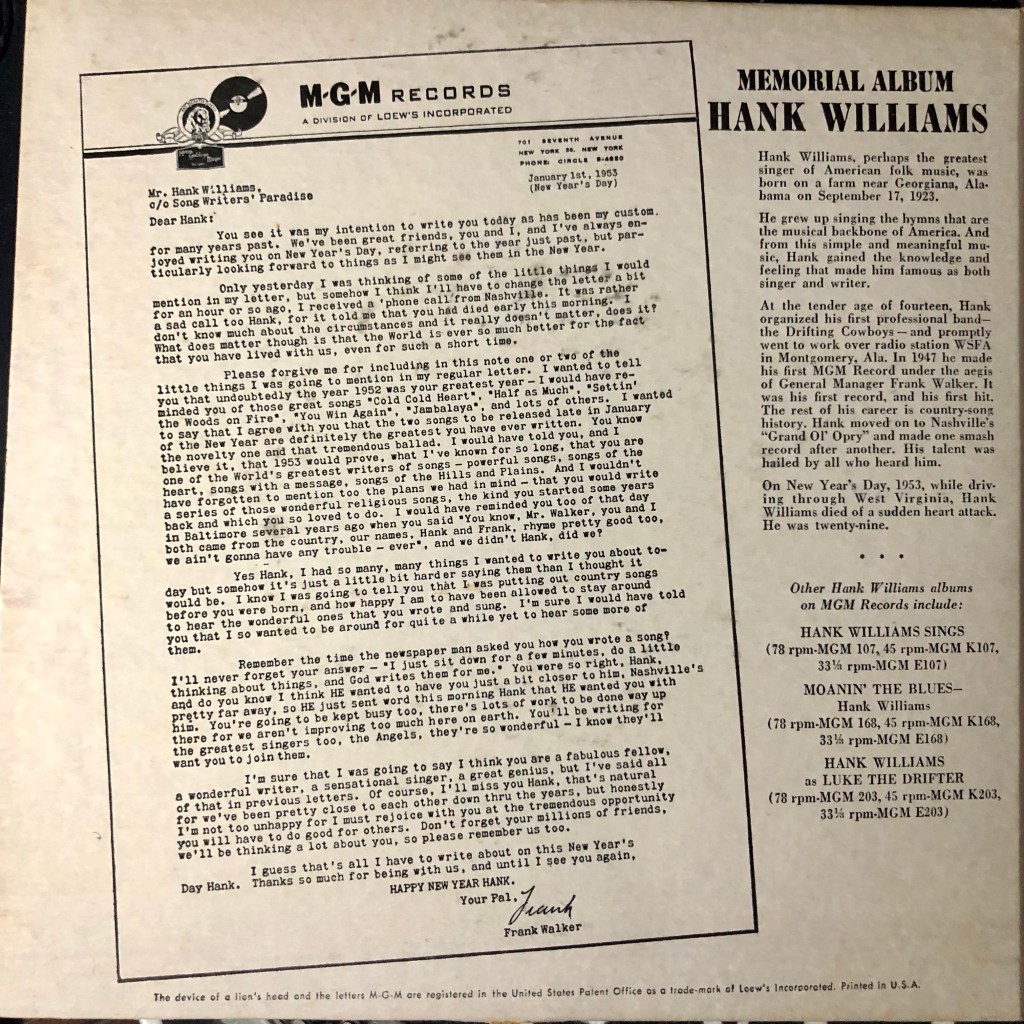
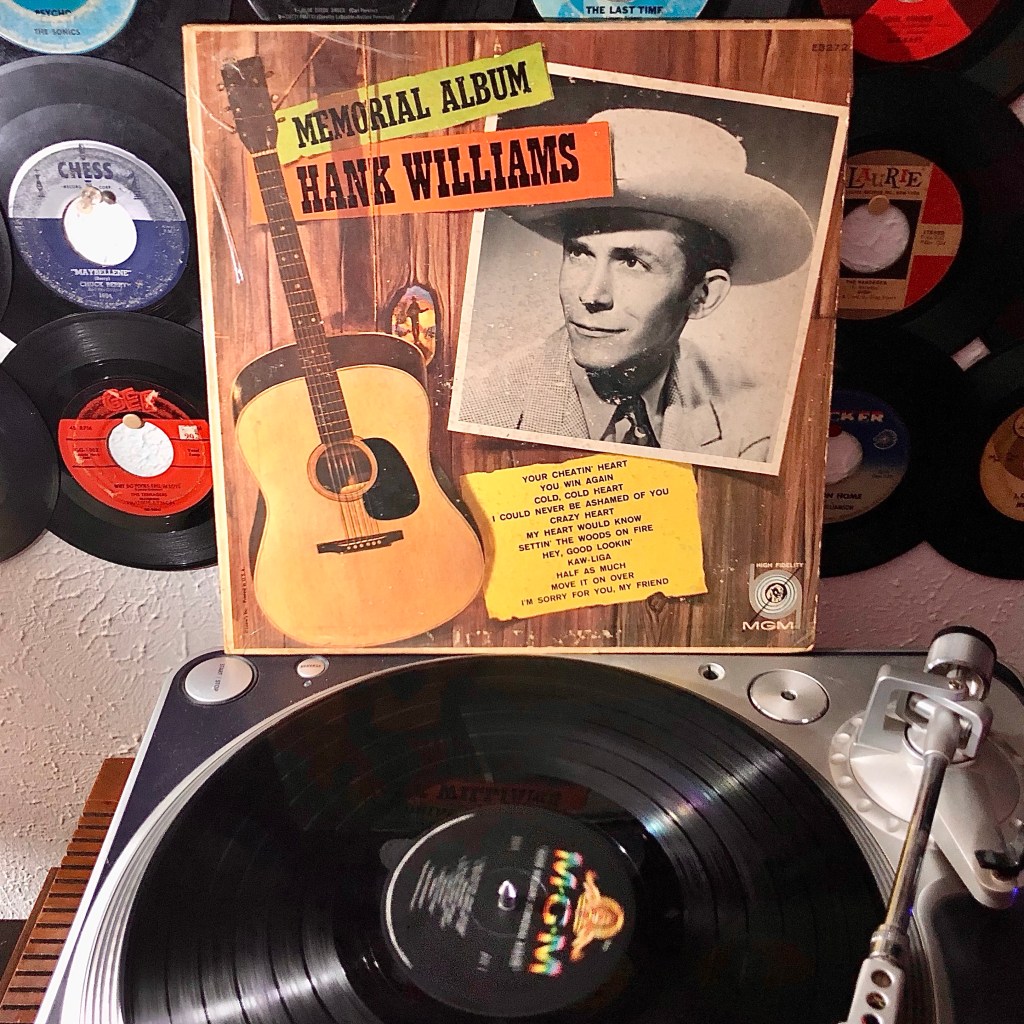
Memorial Album was the first album and retrospective of Hank’s career to be released after his death, with the usual 8-song 78/45/LP releases, but also a 2 disc 45 EP set which I have. Inside the gatefold is a letter written by Frank Walker hours after learning of Hank’s passing. I also have a 1959 reissue of the expanded 12 track LP, which has some of the lamest cover art. I’ve included the full album on the playlist.
Hank Williams as Luke The Drifter (1953)
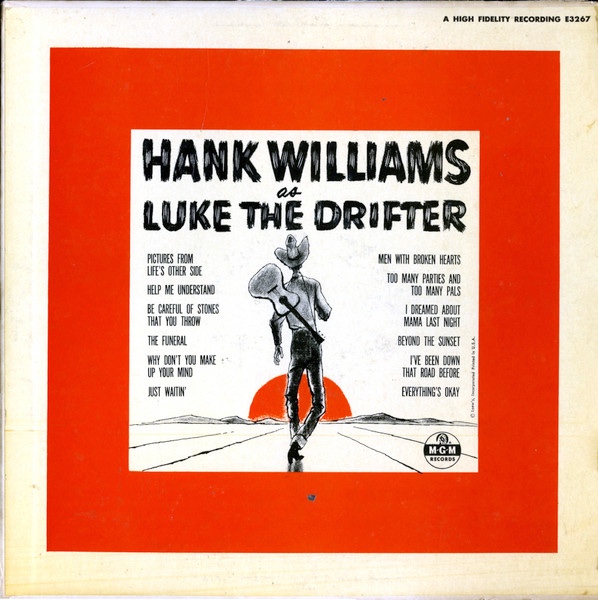
It’s really difficult to explain just how remarkable Hank Williams career and specifically his songwriting had gone completely atomic in the last three years of his life. After his brilliant cover of “Lovesick Blues”, a 1920s vaudeville number that was his first number one and garnered six encores during his legendary Grand Ole Opry debut, he followed it with a list of songs that might take other artists a decade to amass. It was during this period that Hank also began writing and recording a completely different set of songs that were like sermons, where he would talk more than he sang, and tell stories of sorrow and joy. It was decided to release these songs under the pseudonym “Luke The Drifter”, an alter-ego or as Hank would sometimes say, a relative of his. These folk recordings didn’t sell much, but were very influential on artists like Bob Dylan. I love the Luke material and have several of the different versions of the full album (except the red bordered original cover, which I really, really want), but for the playlist I only picked five songs. “Be Careful Of Stones That You Throw” never fails to make me weep. The most popular of the Luke songs was the haunting “Ramblin’ Man”, which didn’t appear on the album but is included on Mercury Nashville’s expanded edition. MGM would release it on a later album of the same name, and I chose to place it on the playlist within that sequence. If Hank had only written one song, “Ramblin’ Man” may have still made him a legend.
Honky Tonkin’ (1954)
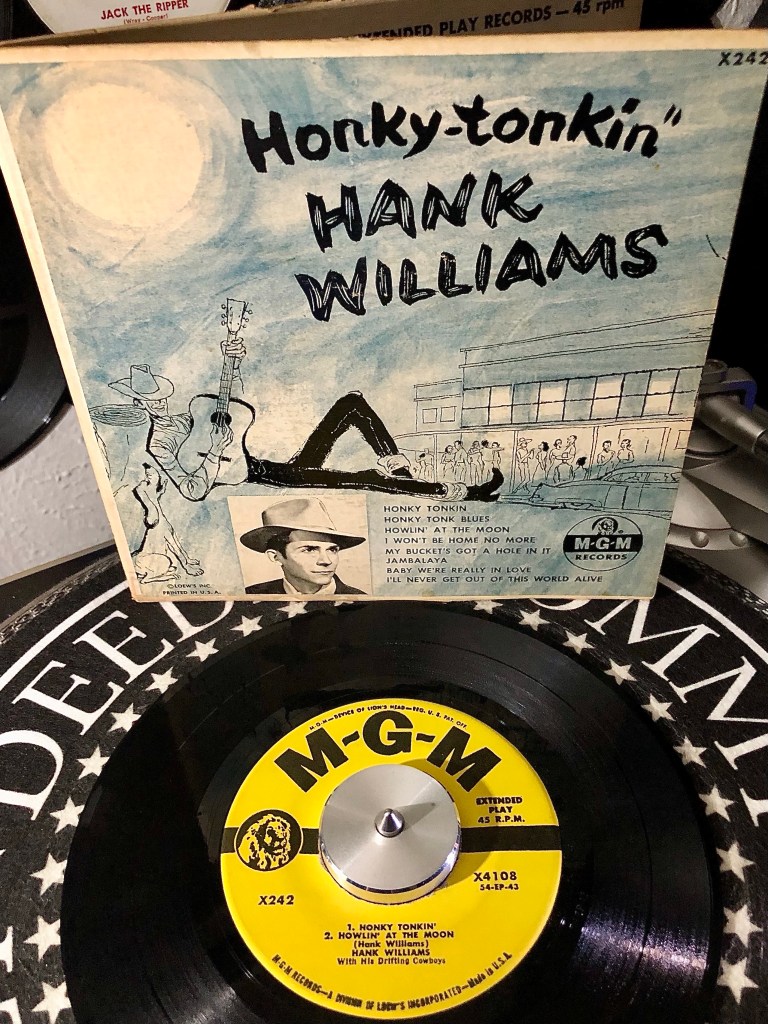
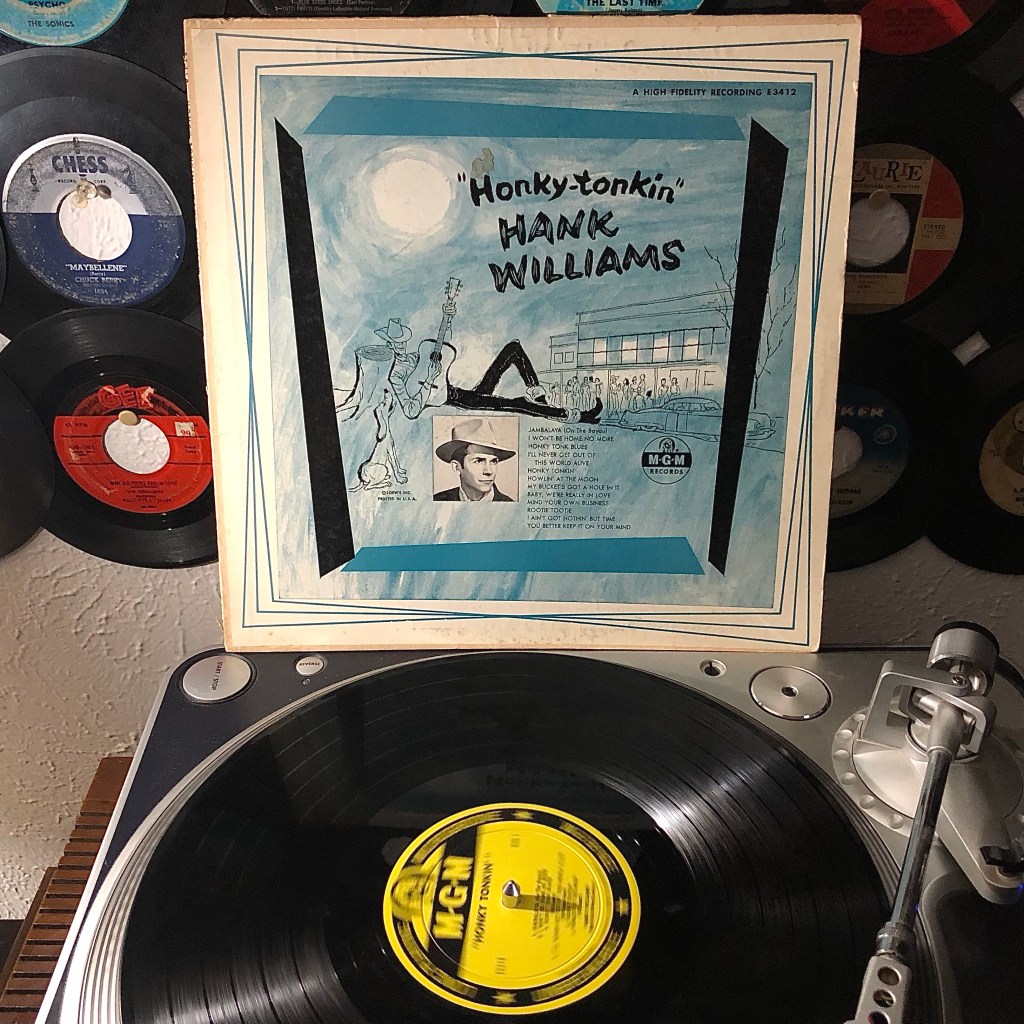
Another stellar collection of hits and classics, including “I’ll Never Get Out Of This World Alive”, which has the eerie position as being the last Hank Williams single released before his death. The song had been recorded in July of 1952, but many have spread the myth that it was the last song he ever recorded. The 8-song 10”/78/45 releases were expanded on the 12” LP with toe-tappers “Mind Your Own Business” and “Rootie Tootie”, and closed out with “I Ain’t Got Nothin’ But Time” and “You Better Keep It On Your Mind”, two songs that were originally extreme, raw lo-fi demos given the overdub treatment here (and of course restored today). All four bonus cuts also appeared as a separate 45 EP which I owned before I heard the undubbed versions. My mind was pretty blown when I first heard them. It was kinda of like hearing a garage punk side of Hank. And I actually dig the overdubbed versions too with the distorted vocals.
I Saw The Light (1954)
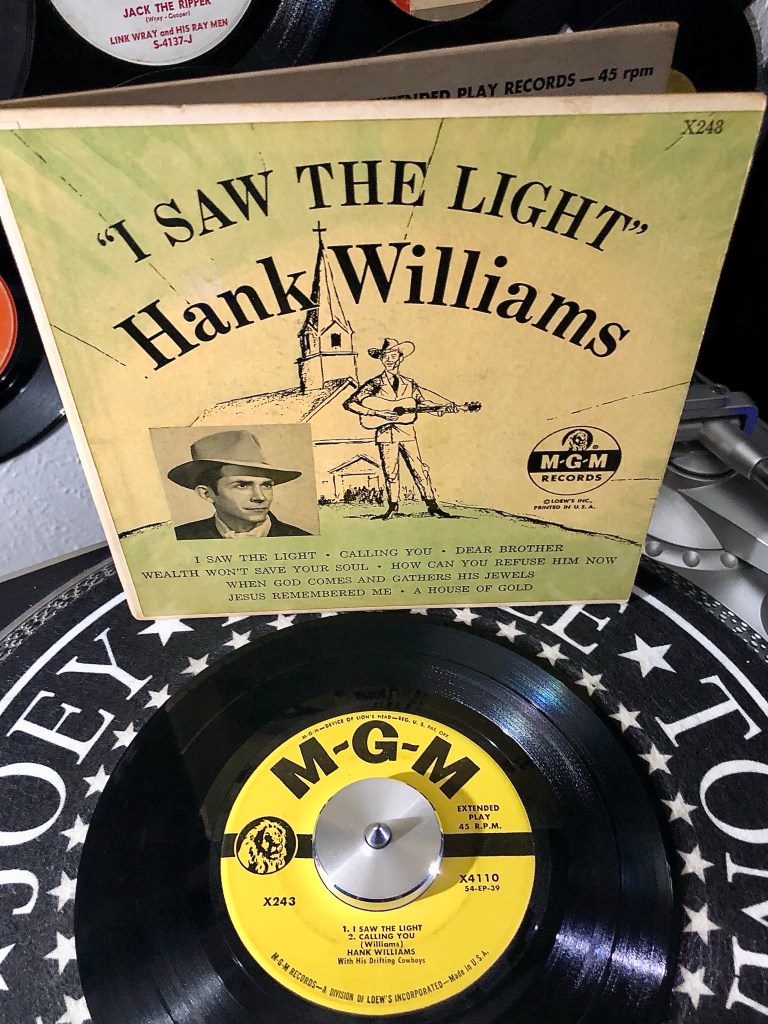
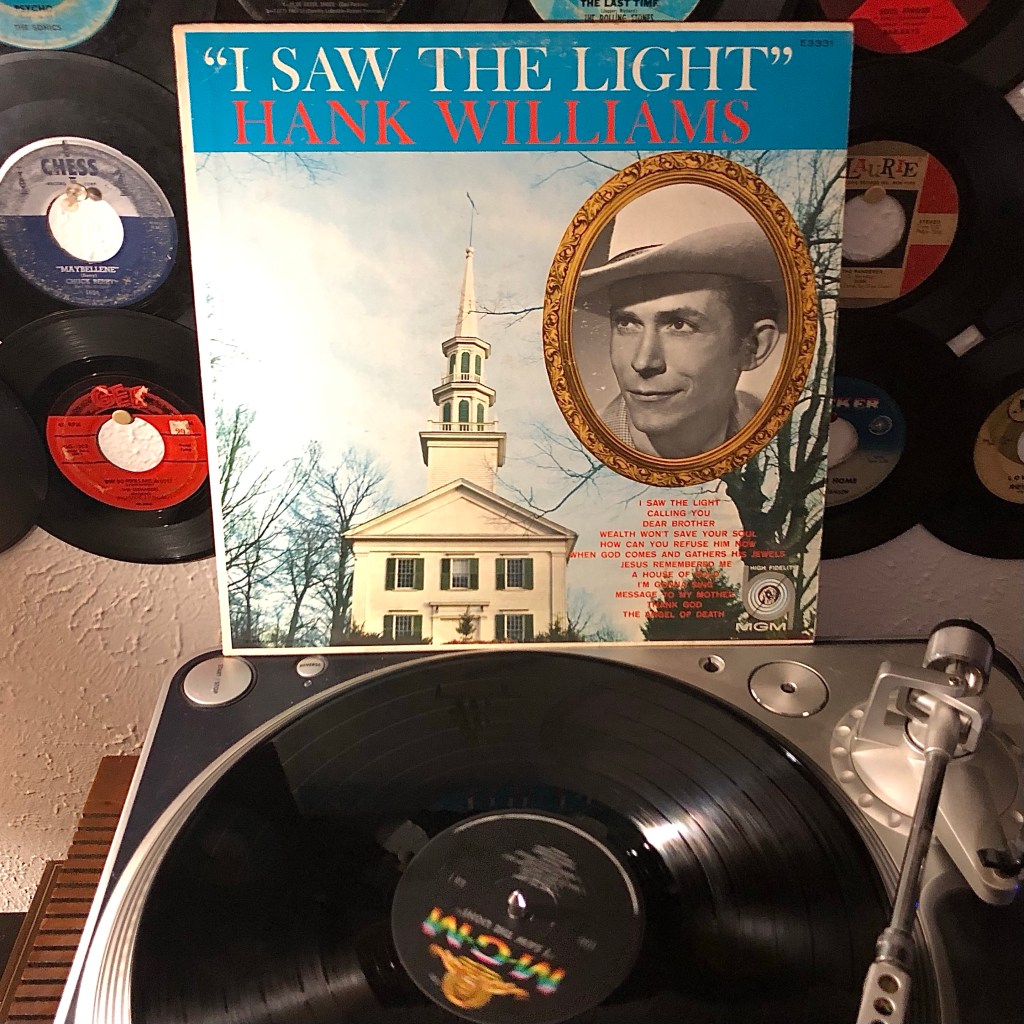
Hank Williams recorded many Gospel songs but only a few were released before his death. He performed many live and did entire radio performances of Gospel songs, often joined by his wife Audrey on vocals. “I Saw The Light” was recorded during his first sessions for MGM and released as a single in 1948, but was not successful. It was however very popular live as he would close most of his performances with it. The final scene in the film I Saw The Light, where upon learning of his death the audience begins singing the song, really did happen.

The album I Saw The Light (which I have the ‘54 2×7 and the ‘59 reissued LP), was the first full album of Hank’s Gospel songs, which included “Calling You” (the B-side of his first single). “Dear Brother” has some the prettiest Hawaiian-style steel guitar and mandolin. Of the added tracks to the 12” LP, “The Angel Of Death” stands out as a tremendous song, especially in its undubbed state. It’s a favorite of another of my heroes Billy Childish, who recorded it with his group The Chatham Singers, featuring his wife Julie on lead vocals.
Ramblin’ Man (1955)

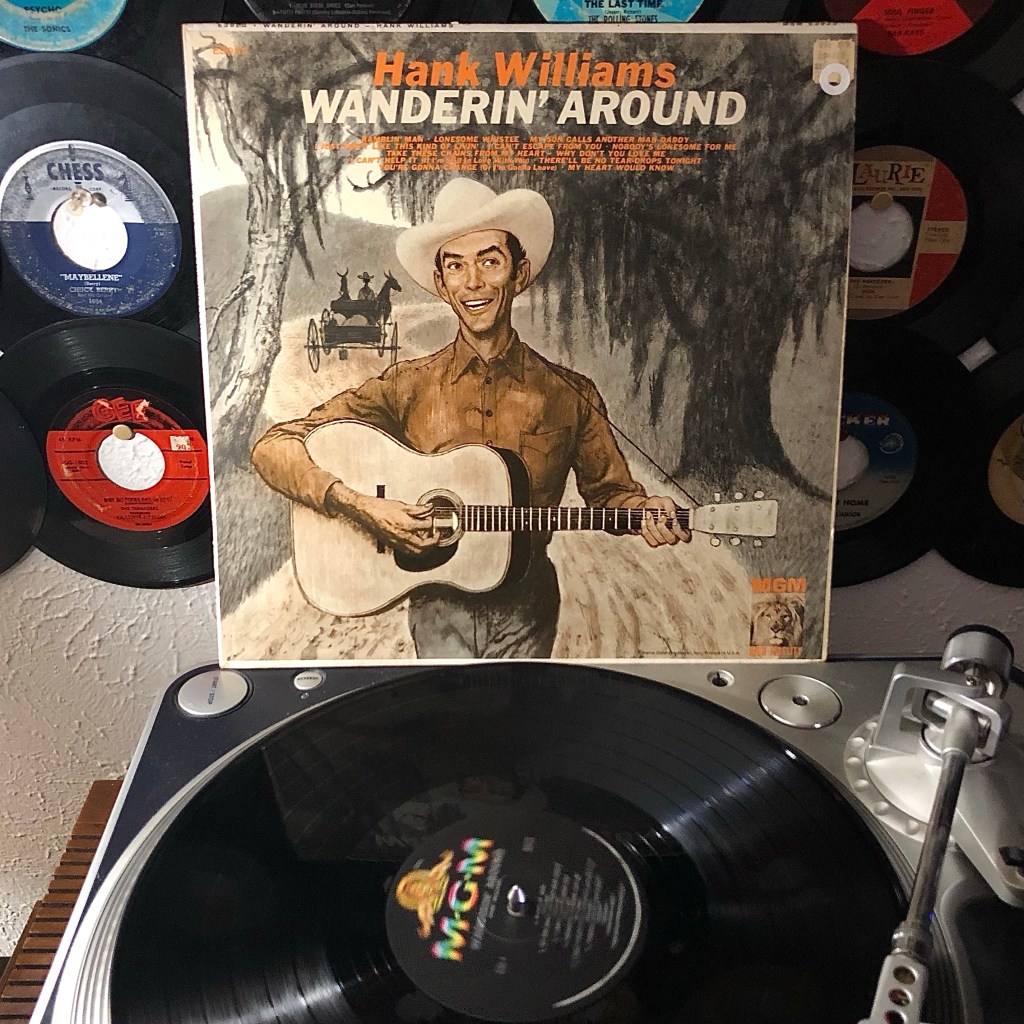
This was the last of the first stretch of Hank albums packed with hits and songs that have appeared on countless greatest hits collections. Only “I Can’t Escape From You” is a previously unreleased demo that’s been overdubbed. Not much else to say about this killer LP. It was reissued in 1961 as Wanderin’ Around. It’s not the only one that was repackaged with a different title and artwork but with the exact same versions of the songs. One way to look at is it’s the music business at its vampiric best, or just more cool Hank records for me to collect. I’ve included every song but two on the playlist; “My Heart Would Know”, which had already appeared on Memorial Album, and “My Son Calls Another Man Daddy”, a song I found confusing trying to figure out who Audrey was with after their divorce, but it turns out that Hank didn’t even write it. I have no kids of my own, but I find the song is just too sad. Bocephus only had one dad, dammit!
Sing A Blue Song (1957)
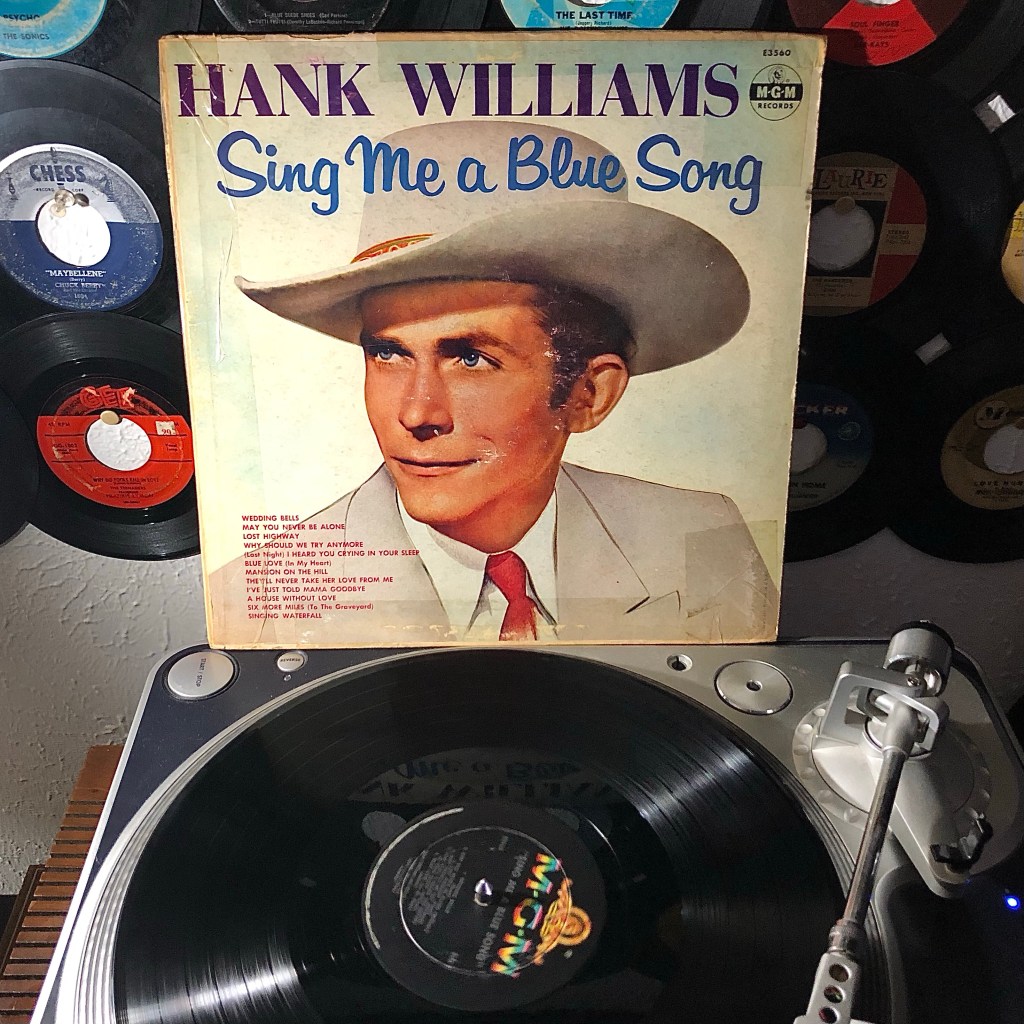
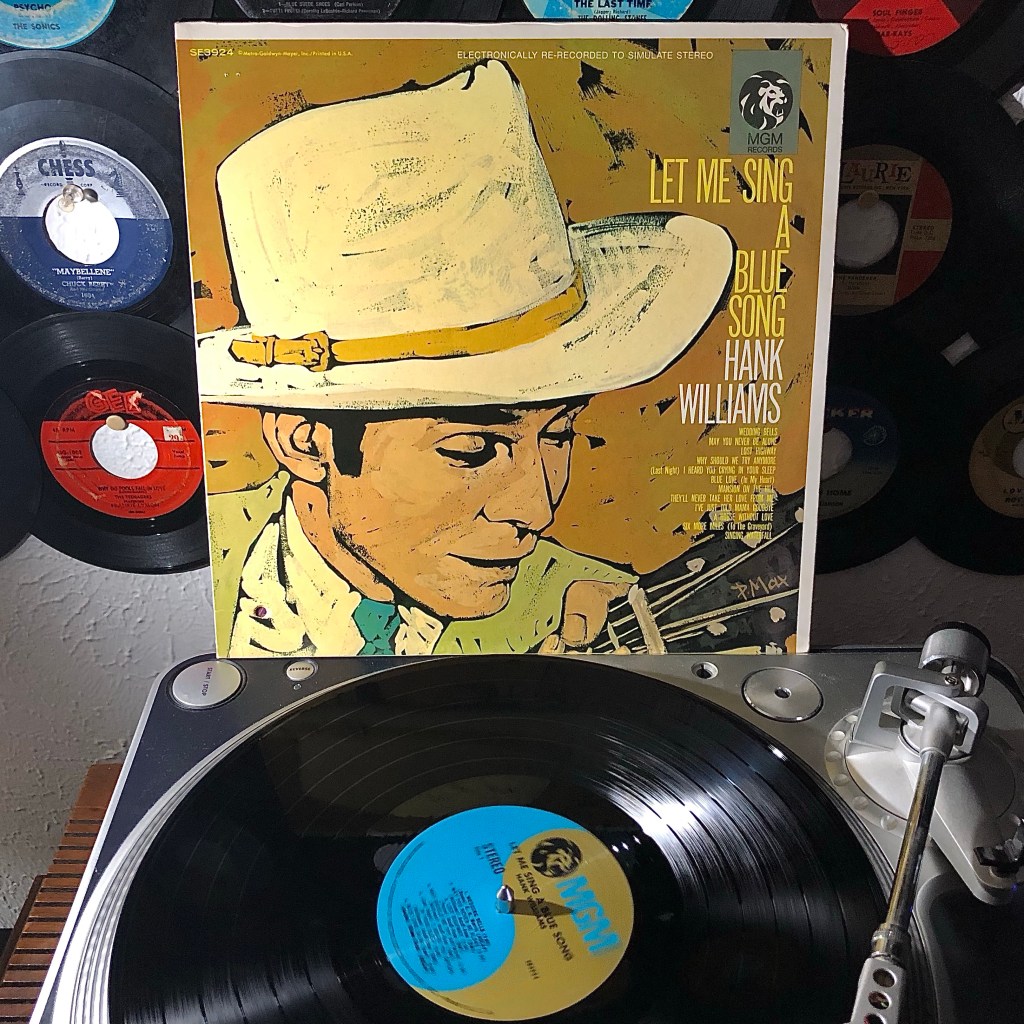
At this point MGM began repeating themselves. In 1957 they would release the first Hank Williams greatest hits package, a double-LP cleverly titled 36 Of His Greatest Hits. The same year they released Sing A Blue Song, taking six of the eight songs from his debut album and six lesser-known songs. It is a fantastic collection that reintroduced classics like “Lost Highway”, “Wedding Bells”, “Mansion On The Hill”, “They’ll Never Take Her Love From Me” and “Six More Miles (To The Graveyard)”. They left Hank and his guitar alone on “Blue Love (In My Heart)”, a previously unheard demo. Same for the touching album closer “Singing Waterfall”, which tells the story of a grieving man who returns to a waterfall in the mountains where his sweetheart is buried. Hank never explains how she died, but explains how he dreams of seeing and embracing her there. It’s like a ghost story where her spirit is trying to pull him to the other side.
Last night as I lay dreamin’
I heard my darlin’ call
And then I went to meet her
By the singin’ waterfall
She took me in her arms
Just like she used to do
And then I heard her whisper
We’ll meet beyond the blue
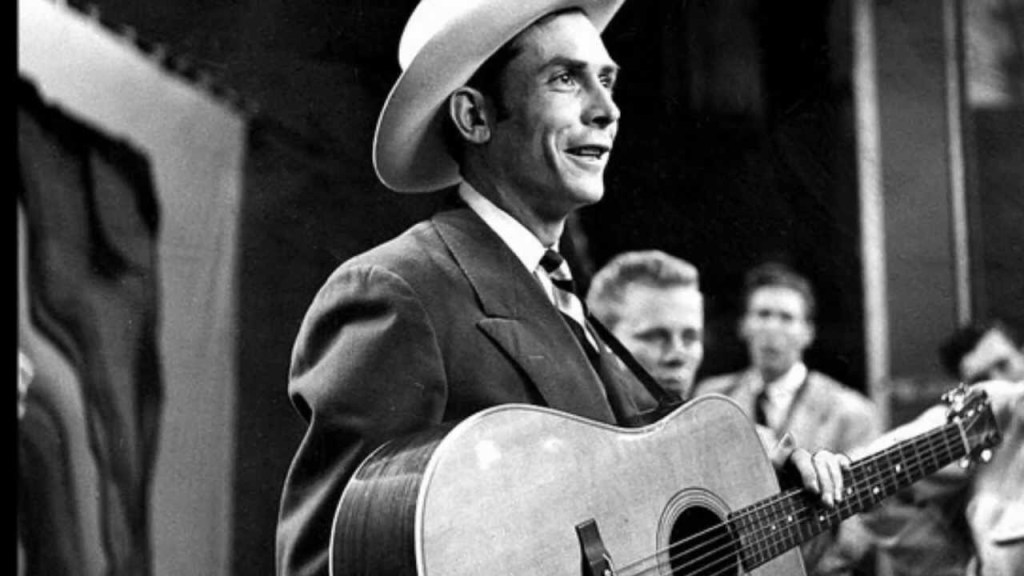
Since most of the tracks appear in other places, I’ve only picked three for the playlist. In 1961, MGM re-released this album with the altered title of Let Me Sing A Blue Song, and par for course, the songs are all overdubbed with extra sounds. Although hearing “Lost Highway” this way feels like blasphemy, I’m really not complaining. These enhanced versions have their own charm. I know which versions I would rather hear, but at the end of the day it’s still Hank Williams. And OMG this is my favorite album art of any Hank Williams record.
The Immortal Hank Williams (1956)
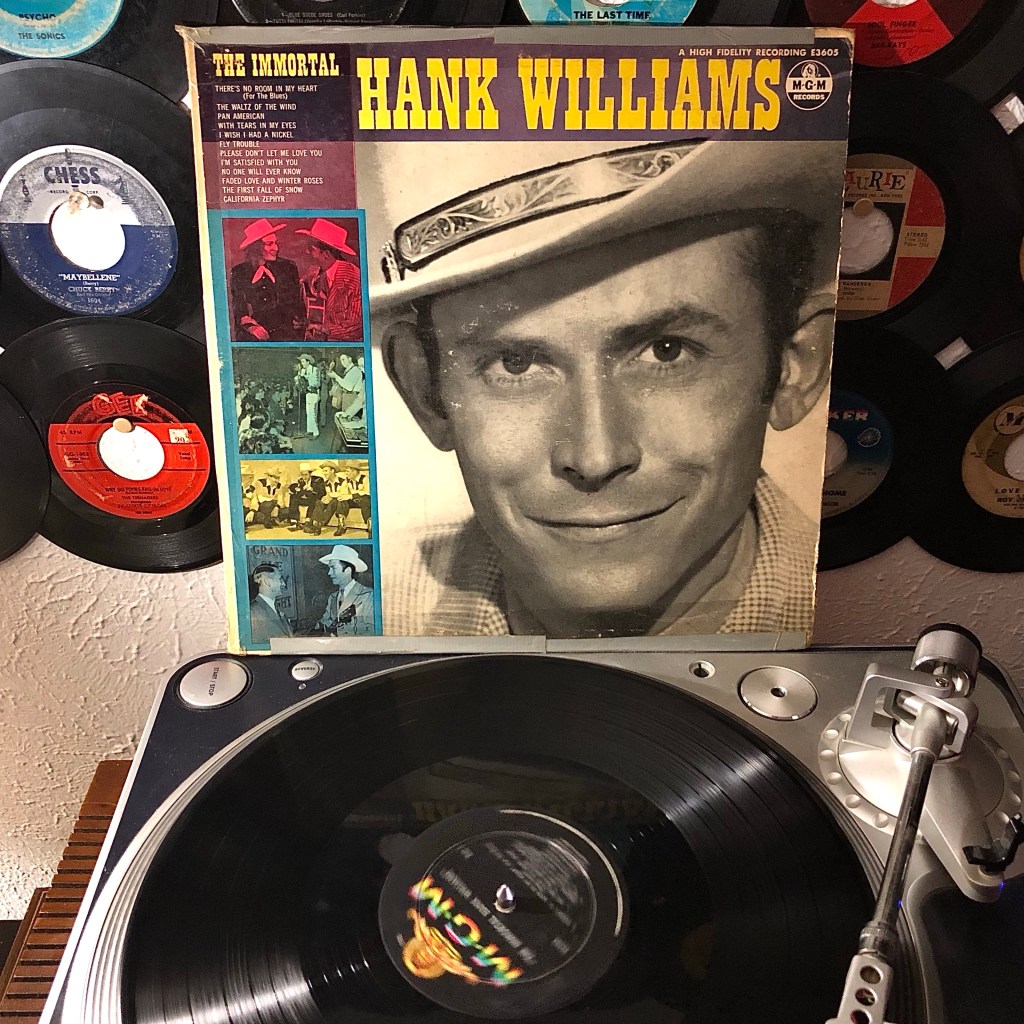
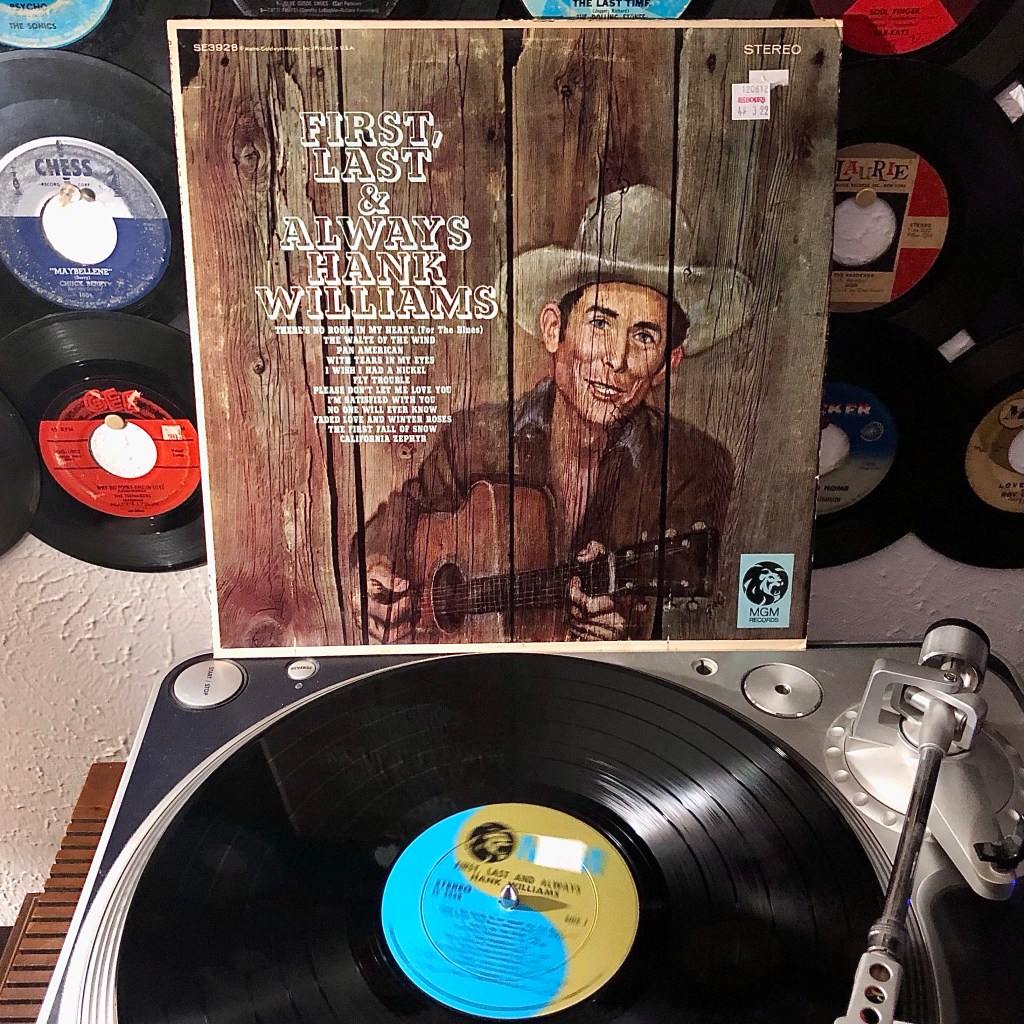
Three years after Hank’s passing, MGM had released seven LPs (including the two albums released before his death) filled with all of non his most popular songs as well as several B-sides, and even a few previously unreleased demos that have since been recognized as classics. Then they just started putting out the never ending string of “Greatest Hits” packages, but continued to release collections with more unreleased demos and obscure singles. The Immortal Hank Williams contained early recordings like the Western Swing-styled “Fly Trouble”, and “I’m Satisfied With You”, and “Pan American”, which has been described as Hank’s answer to The Carter Family’s “Wabash Cannonball”, popularized by his idol Roy Acuff. It was also his fourth and final single for Sterling Records before he jumped to MGM. Despite having no hits, this is a fun record that mixes up heartbreaking ballads, uptempo dance numbers, and great American folk music. In 1961, MGM would re-release the album with overdubbed extra instruments as First, Last & Always.
The Unforgettable Hank Williams (1959)
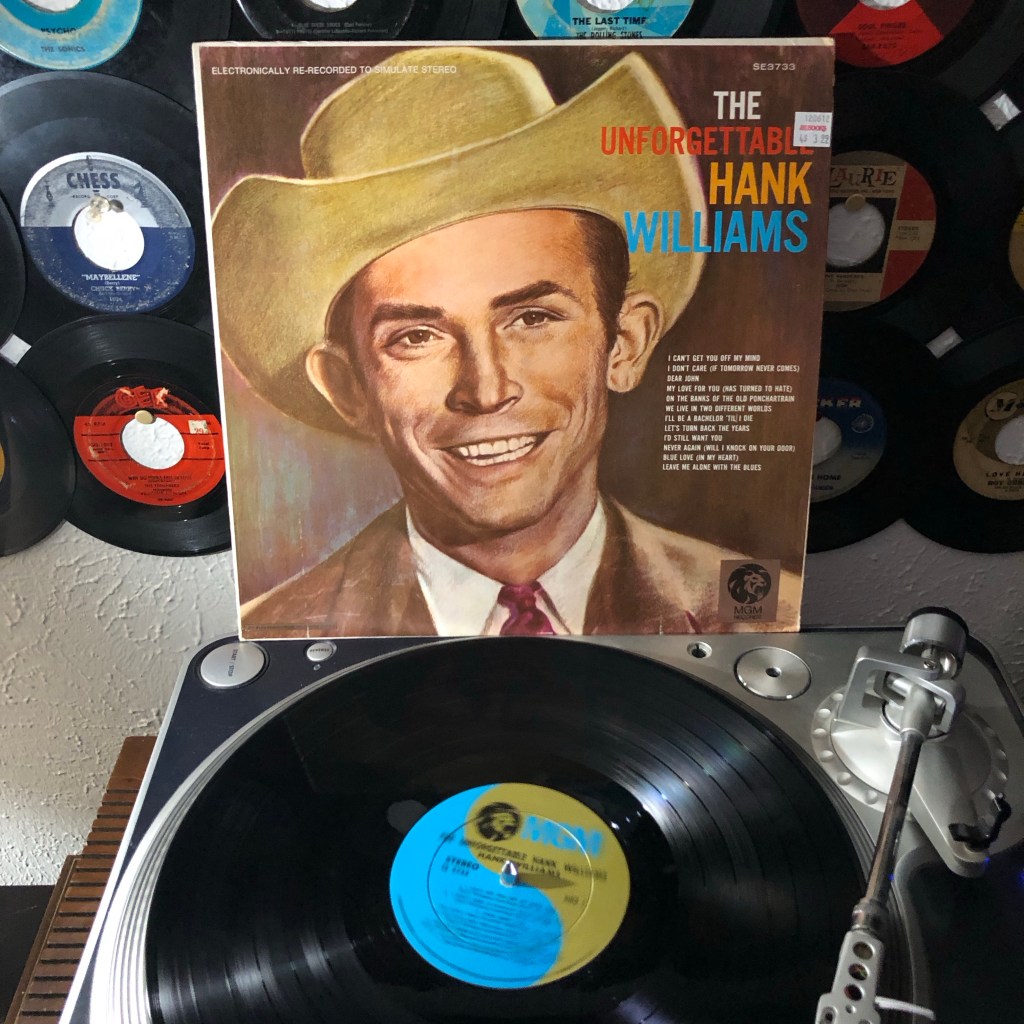
Maybe the best of the non-hits collections, this album has several B-sides like opener “I Can’t Get You Off Of My Mind”, “I’d Still Want You”, and “I’ll Be A Bachelor ‘Til I Die” that should have been hits on their own. It also includes the A-side of Hank’s 1947 debut single “Never Again (Will I Knock On Your Door)”, as well as both sides of his third single for Sterling Records, “My Love For You (Has Turned To Hate) b/w “I Don’t Care (If Tomorrow Never Comes)”. But my favorites will always be the solo demos like the Fred Rose-penned “We Live In Two Different Worlds, and Hank’s “Blue Love (In My Heart), and “Leave Me Alone With The Blues”. Despite being another overdubbed album, it’s quite enjoyable.
The Lonesome Sound of Hank Williams (1959)
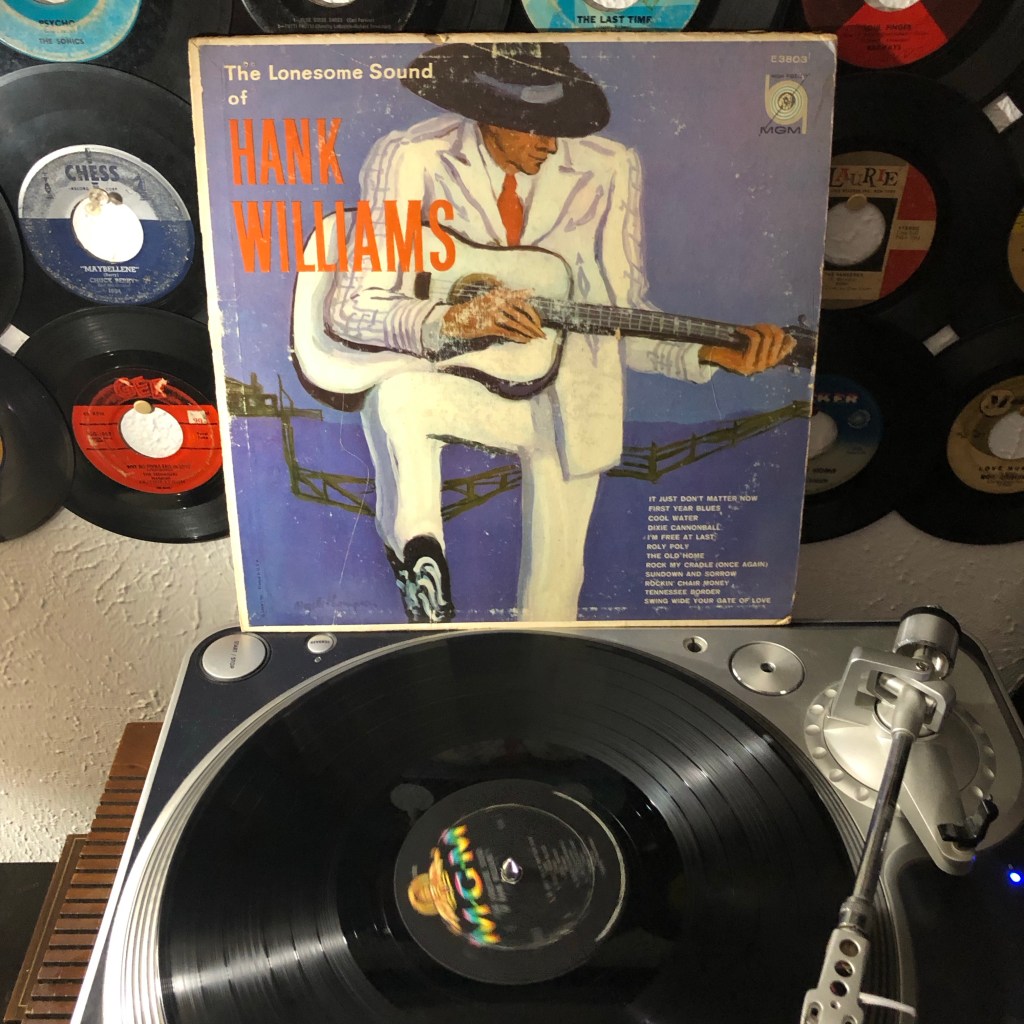
Another cool collection, with very cool artwork, tragically overdubbed. All but two of these tracks came from solo demos and solo live radio performances, several of which have the giveaway of Hank introducing the song before he begins the song. Because I heard these undubbed versions from the box set first, I was really shocked at the way they sound on this record. I guess they thought by adding fiddle and percussion to “It Just Don’t Matter Now” it wouldn’t sound so depressing when Hank sings “all my life I’ve been a loser…”. Another song that kills me here is “Cool Water”. It was the final track on Lost Highway And Other Folk Ballads, my first Hank album, and there it was such a gripping Western ballad. I was always sad when I had to pick the needle up. Here they add steel guitar that makes it more upbeat like The Sons Of The Pioneers’ original, and takes away the desolation of a song about a man wondering a barren land, hallucinating about the Devil and having conversations with his mule named Dan. It makes you thirsty just hearing it. In Bob Dylan’s book The Philosophy Of Modern Song, Bob spends a chapter on Hank’s “Your Cheatin’ Heart”. He says “Hank is one of those rare artists that can sing anything and make the song his own.” He mentions “Cool Water” as an example. I agree with Bob. Hank’s version is definitive.
The Spirit Of Hank Williams (1961)
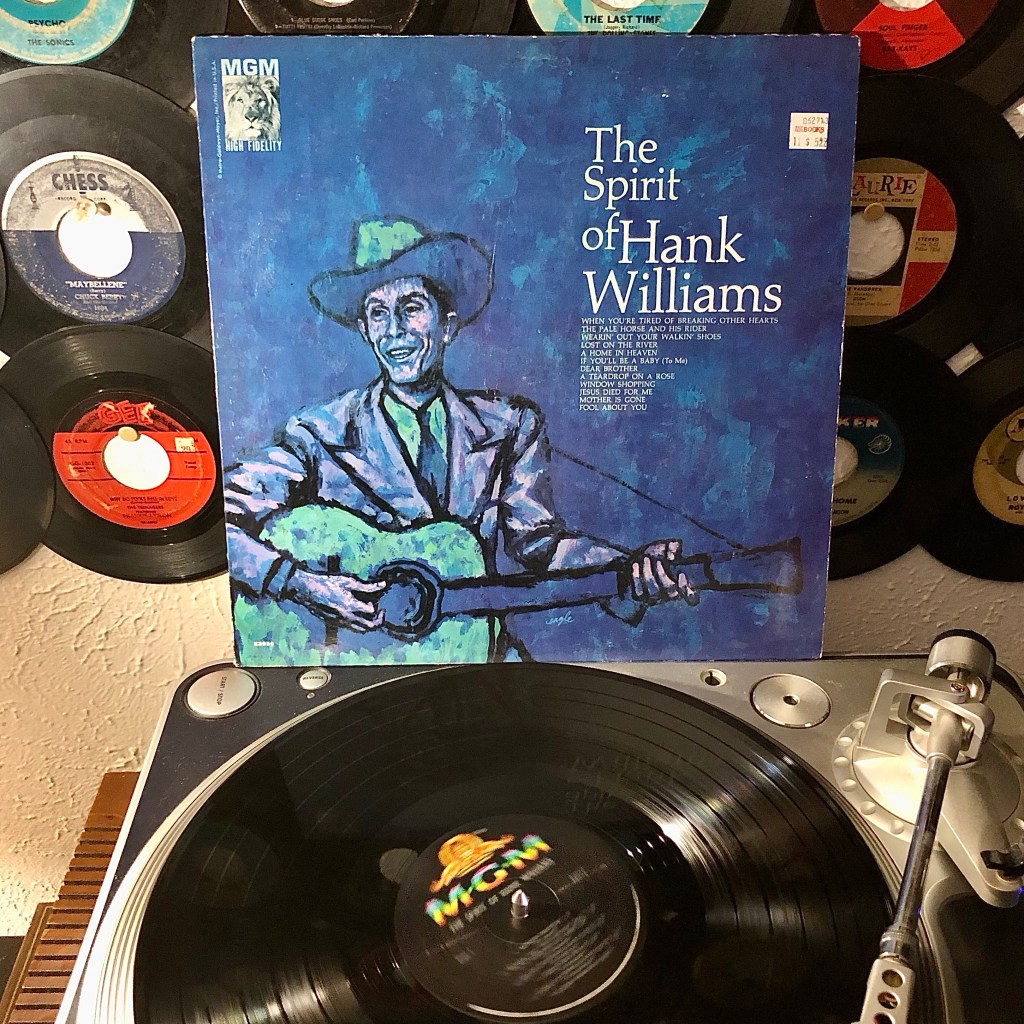
This is one of the weirdest and wackiest of the overdubbed collections. First of all, half the album is made up of Gospel songs, which all feature Hank’s wife Audrey on vocals. And a couple of them are really great, like “Lost On The River” and “Dear Brother”. Things kick off with “Window Shopping”, the great B-side of “Jambalaya (On The Bayou)”. Surprisingly, I kind of enjoy the extra instrumentation on “Wearin’ Out Your Walkin’ Shoes”. It’s got a cool Blues groove to it. The enhanced elements on “If You’ll Be A Baby (To Me)” aren’t bad, but they sort of rob the listener of the sweetness of the original. But the craziest cut here is “Fool About You”, where the extra arrangement is a total Rock ‘N’ Roll/Rockabilly rave up. It sounds like it could have been an Elvis song from the same period. It’s fun and ridiculous at the same time. The best is “Mother Is Gone”, where the only other instrument beside Hank’s guitar is an organ. For once, it’s a divine intervention.
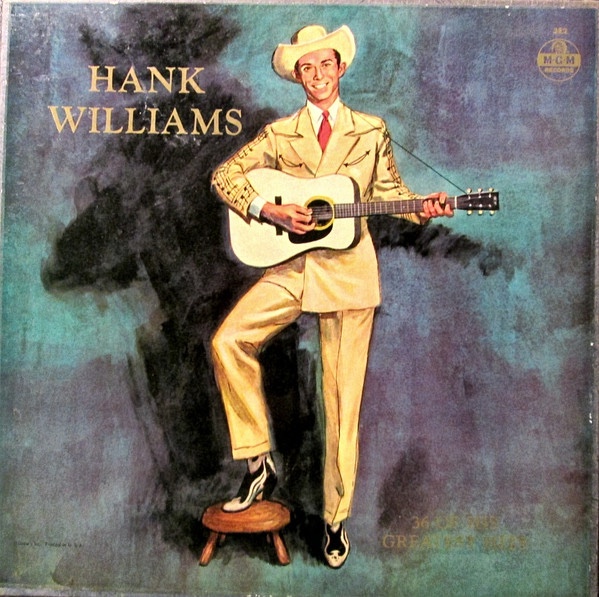
No surprise, but I did not include any overdubbed songs on my playlist. Feel free to look them up on YouTube. They’re all worth a listen. For the rest of the playlist I dip deep into the well of The Complete Hank Williams for a few more demos and live recordings. One the great surprises of the box was the original demo of “There’s A Tear In My Beer”, written in 1951 but rejected by Fred Rose who didn’t think mentioning alcohol in a song was appropriate. The fact that Hank had a reputation as an alcoholic, it probably was a good move. Instead, Hank gave the song to singer Big Bill Lister who did release his own version in ‘52. Nearly 40 years later, Lister found the old acetate Hank had given him and Lister gave it to Hank Jr. who used it to create a duet with his father and it was a huge smash hit and a cutting edge video was made using old footage of Hank Sr. Today it is considered yet another classic song by Hank that most likely would have been a big hit had he released his own version. Despite Rose’s objection, I think the song has some of Hank’s greatest lines, like “Into these last nine beers, I have shed a million tears” or “I’m gonna keep drinkin’, until I’m petrified” or “I’m gonna keep drinkin’, ‘til I can’t move a toe. And then maybe my heart, won’t hurt me so”. Shakespeare couldn’t have written it better. And the refrain “You are on my lonely mind” just gets me right there. Trust me, I’ve been there.
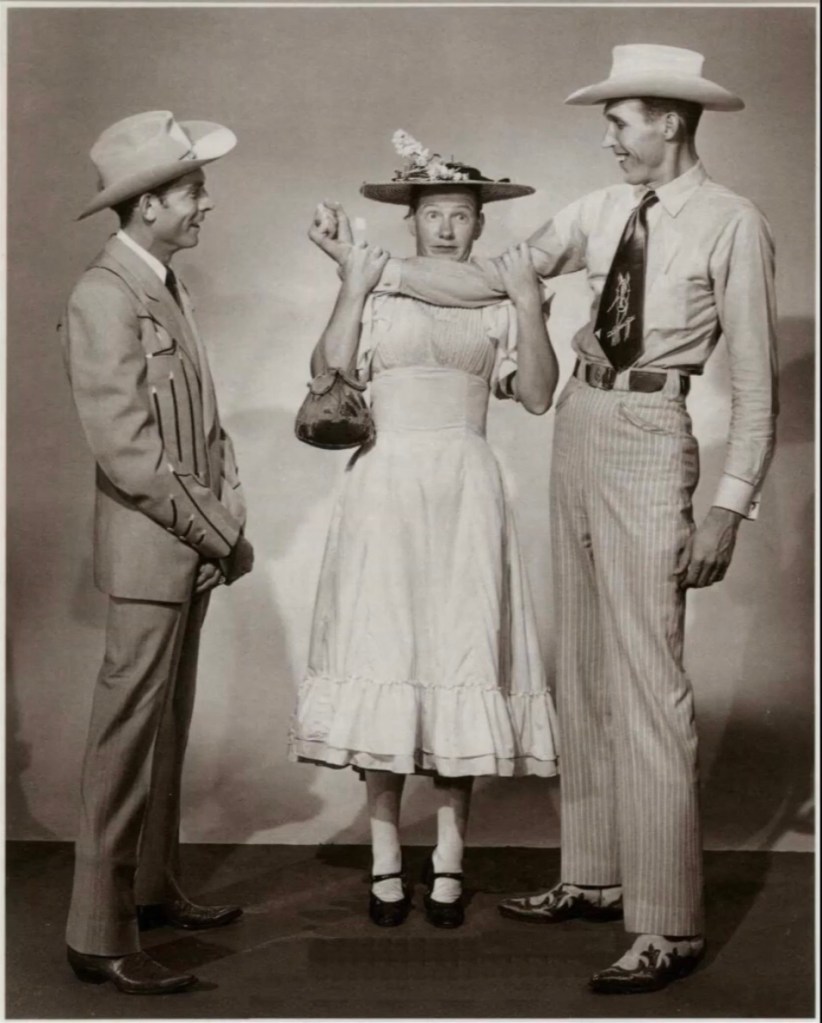
Of the 225 tracks on the box set, several were live recordings including a remarkable duet of “I Can’t Help It (If I’m Still In Love With You)” with Anita Carter. The recording comes from the Kate Smith Evening Hour television show, one of the few pieces of footage of Hank performing. When they harmonize on the song’s bridge it simply gives me the chills. I also included a live version of “They’ll Never Take Her Love Away From Me”, which I chose over the studio recording. It’s only listed as a “rare radio performance”, so I’m not sure where it was recorded, but there’s some funny chatter with the DJ, and someone makes a joke about “rigor mortis setting in”. In a weird twist, when it was discovered that Hank was dead in the backseat of his car, it was said that it looked like rigor mortis had set in hours before and it might be possible that he had passed before midnight, making his death date December 31st, 1952, but alas, he was officially pronounced dead on New Year’s Day.
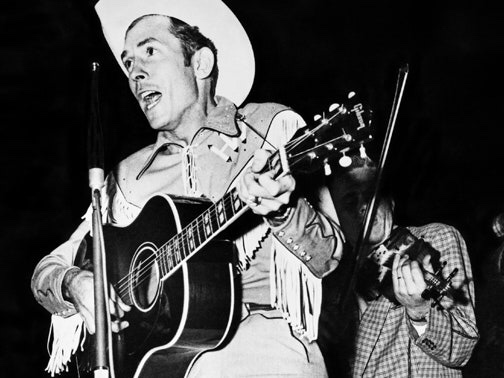
A few years after the release of the box set it was discovered there were many more live radio Hank Williams performances, so I don’t really know the actual total number of Hank Williams recordings there are. One that I didn’t hear until much later was “Blue Eyes Cryin’ In The Rain”. It was written by Fred Rose and originally recorded by Roy Acuff, and of course was a number one hit for Willie Nelson. Hank’s version is absolutely beautiful. Obviously it brings up the question: why didn’t Hank record and release his own version? Would it have been a hit and would Willie’s version have still been so huge? Coincidentally, Willie recorded a cover of “I Can’t Help It (If I’m Still In Love With You)” during the Red Headed Stranger sessions that appears as a bonus cut on the CD.
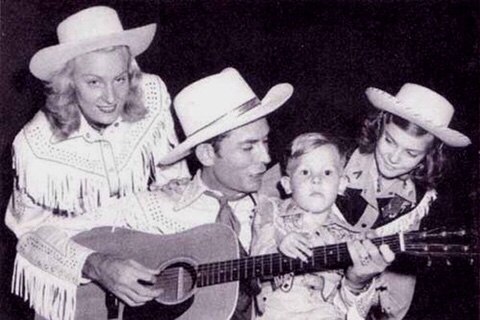
So there it is. If you’ve read this whole thing, thanks. If you spend a day or two with my playlist, that’s cool, but seriously, just listen to some Hank Williams today. I can’t really get too deep into what his music means to me other than it’s helped me get through some rough times, and that was part of why he was such a sensation 70 years ago. Audiences, especially in the South, identified with him. They truly saw him as one of them and his songs spoke of their own experiences. For this project I’ve read a lot about Hank and his records. I’m not a professional writer, and I don’t think I’m all that good at it despite what my friends tell me. I don’t list all my sources. I borrow photos and may not know who the photographer is. I do this out of love and boredom. This is a mixture of facts I’ve read and opinions I carry about one of my favorite artists. I could try to credit every quote, but when you’re using Wikipedia and the other internet sources, it’s hard to know what are real facts, especially when you’re dealing with historical events from 70 years ago. So many things I’ve read simply had the wrong facts, like Hank’s birthday was Friday or yesterday, or he was 30 when he died and not 29. It can be frustrating for a nerd like me. I’m sure I got some things wrong. I wish I had gotten a copy of Colin Escott’s 1994 book Hank Williams: The Biography, which was the basis for the I Saw The Light film; or Ed Guy’s Hank Williams Discography, said to be the most accurate account of every Hank Williams recording. A lot of info came from a book I’ve had for years, Jay Caress’ Hank Williams: Country Music’s Tragic King, published in 1979. I’ll leave you with a passage from his book that sums it all up:
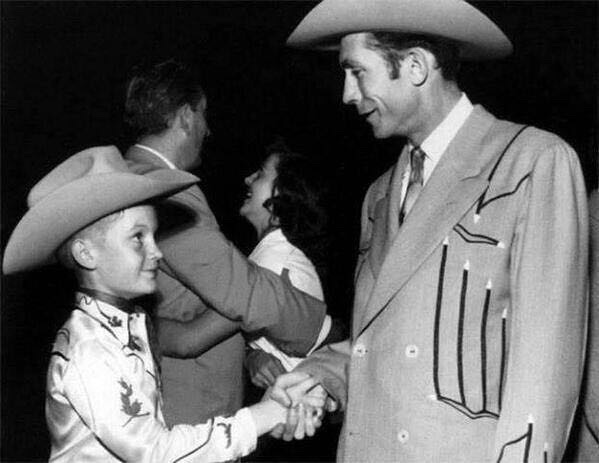
“Hank Williams performed a tribal function for the South. He had absorbed, in his short life, a lion’s share of the common experience of its people. He had known poverty and hard work, he had learned to think of fried chicken as a Sunday delicacy, had loved the trains, the trees, the traditions of the Southern land, got choked up over Momma, fought with his woman, struggled to pay bills, fell hard in love, fought hard when challenged, and drank hard when he couldn’t take it anymore.
Moreover, Hank had been given the gift of recreating his experience for an audience; that is, recreating their experience for his audience. At first, he did it by joining in with the flow of country music as it had been, because he was not the first hillbilly to speak for the hillbilly to the hillbillies.”
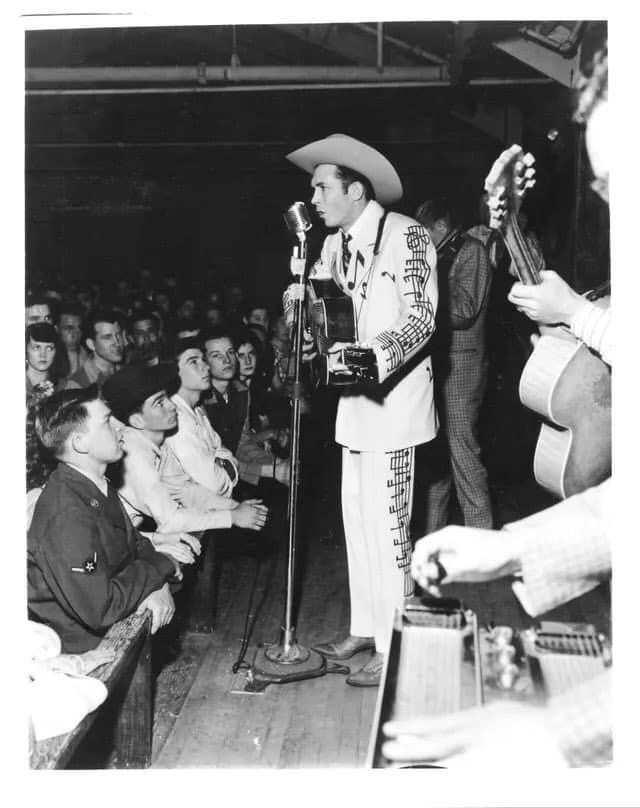
“Hank gave the people the picture of their pain, a reminder of their faith, and an enactment of their escape. Struggle, heartbreak, drowning sorrows at the roadhouse, soberly remembering what Momma used to say about Jesus, corny jokes and ‘ol boy laughter, proudly fighting with the woman and proudly defending the right to fight with the woman, frustration, anxiety, relief, hope, conviction…does it sound like merely a regional encyclopedia of story themes?
If not, then you can understand why this Southern performer could not be held back from becoming an American legend, known and loved as well in Minneapolis as in Mobile.”
 MOJO WORKOUT
Leave a comment